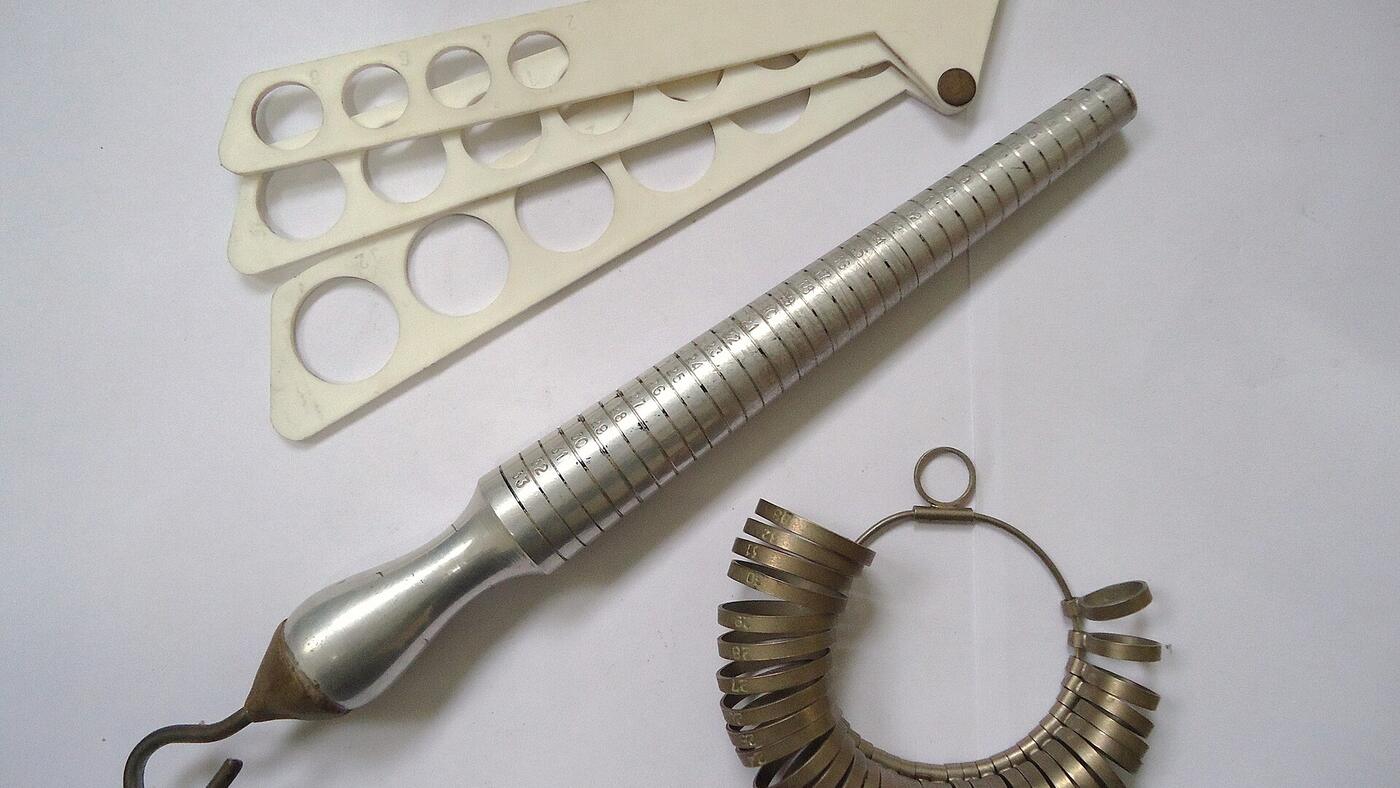
Every country has its own ring size system, and they do not line up neatly. Mainland Europe uses the inner circumference in millimetres (ISO 8653), the UK and Australia use letters, the US and Canada use numbers, Japan its own numbers. The table below puts them side by side.
How to read the table
Find the size you know in its own column and read across. Size EU 54 is a ring with an inner circumference of 54 mm and an inner diameter of about 17.2 mm; the nearest UK size is N½ and the nearest US size 7. The US and UK columns show the nearest half size, so the match is within half a millimetre.
France uses the same number as the EU column. Germany often states the inner diameter in quarter millimetres: 17 ¼ is a 54 mm ring. Italy, Spain and Switzerland use the circumference minus 40, so a 54 there is a 14. Some Dutch jewellers quote the inner diameter as well; that is the second column.
Ordering from a goldsmith abroad? Give the circumference in millimetres. Every goldsmith works with it, and it leaves no room for confusion between the two numeric systems.
The chart
| EU / ISO / France (circumference mm) | Ø mm (Germany) | Inch | UK | US | Italy / Spain / Switzerland | Japan |
|---|---|---|---|---|---|---|
| 41 | 13 | 1.61 | C½ | 2 | 1 | 2 |
| 42 | 13 ¼ | 1.65 | D | 2 | 2 | 2 |
| 43 | 13 ¾ | 1.69 | E | 2.5 | 3 | 3 |
| 44 | 14 | 1.73 | F | 3 | 4 | 4 |
| 45 | 14 ¼ | 1.77 | F½ | 3.5 | 5 | 5 |
| 46 | 14 ¾ | 1.81 | G½ | 3.5 | 6 | 6 |
| 47 | 15 | 1.85 | H | 4 | 7 | 7 |
| 48 | 15 ¼ | 1.89 | I | 4.5 | 8 | 8 |
| 49 | 15 2/4 | 1.93 | J | 5 | 9 | 9 |
| 50 | 16 | 1.97 | K | 5.5 | 10 | 10 |
| 51 | 16 ¼ | 2.01 | L | 5.5 | 11 | 10 |
| 52 | 16 2/4 | 2.05 | L½ | 6 | 12 | 11 |
| 53 | 16 ¾ | 2.09 | M½ | 6.5 | 13 | 13 |
| 54 | 17 ¼ | 2.13 | N | 7 | 14 | 14 |
| 55 | 17 2/4 | 2.17 | O | 7 | 15 | 14 |
| 56 | 17 ¾ | 2.20 | O½ | 7.5 | 16 | 15 |
| 57 | 18 ¼ | 2.24 | P½ | 8 | 17 | 16 |
| 58 | 18 2/4 | 2.28 | Q½ | 8.5 | 18 | 17 |
| 59 | 18 ¾ | 2.32 | R | 9 | 19 | 18 |
| 60 | 19 | 2.36 | S | 9 | 20 | 18 |
| 61 | 19 2/4 | 2.40 | S½ | 9.5 | 21 | 19 |
| 62 | 19 ¾ | 2.44 | T½ | 10 | 22 | 20 |
| 63 | 20 | 2.48 | U | 10.5 | 23 | 21 |
| 64 | 20 ¼ | 2.52 | V | 11 | 24 | 23 |
| 65 | 20 ¾ | 2.56 | W | 11 | 25 | 23 |
| 66 | 21 | 2.60 | W½ | 11.5 | 26 | 24 |
| 67 | 21 ¼ | 2.64 | X½ | 12 | 27 | 25 |
| 68 | 21 ¾ | 2.68 | Y | 12.5 | 28 | 26 |
| 69 | 22 | 2.72 | Z | 12.5 | 29 | 26 |
| 70 | 22 ¼ | 2.76 | Z½ | 13 | 30 | 27 |
| 71 | 22 2/4 | 2.80 | Z1 | 13.5 | 31 | – |
| 72 | 23 | 2.83 | Z2 | 14 | 32 | – |
What a step means
A whole EU size is one millimetre of circumference, or about 0.3 mm of diameter. A US size is 2.5 mm of circumference, a UK letter 1.25 mm, a Japanese size 1 mm. Half sizes exist in the US and UK systems; in Europe a goldsmith simply makes a 54.5.
Wide bands
A band of about 6 mm or wider sits tighter than a slim ring of the same size, because more skin has to fit under the metal. Reckon on half a size to a full size larger, and if you can, try a wide sizing ring rather than a thin one.
Between two sizes
Take the larger. Making a ring smaller is simpler than making it larger, and a ring that will not pass the knuckle is no ring at all. Read how to measure a ring size before you decide, and resizing a ring for what is possible afterwards. Men's fingers run larger than the middle of this chart; the men's ring size guide covers that range.
When a goldsmith makes the ring for you, the size becomes part of the conversation. Describe your ring and name the size in any system you know.