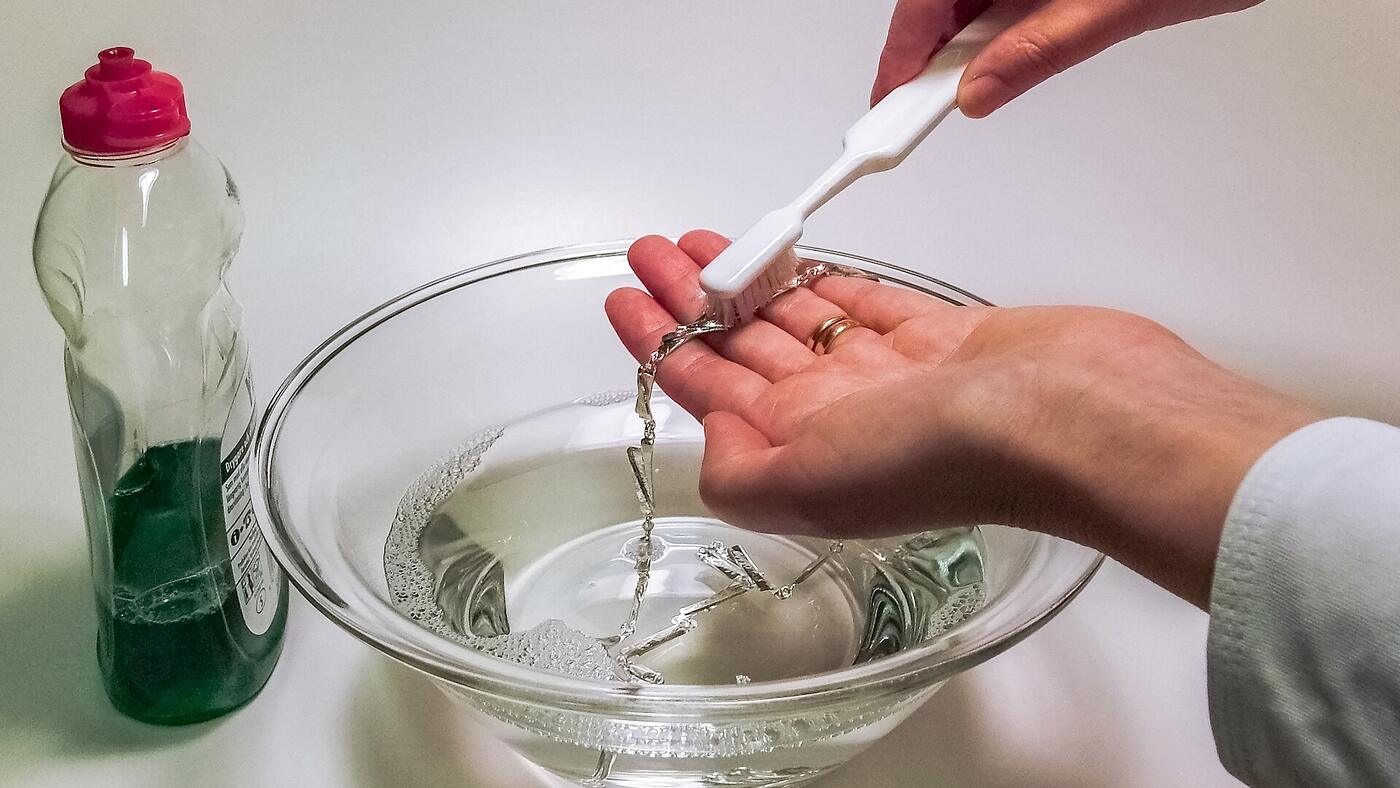
Most jewellery needs very little: keep it clean, keep it away from a few things, and have it checked now and then. What is safe depends on the metal and the stones.
The rule that covers most pieces
Warm water, a drop of mild washing-up liquid, a soft toothbrush, rinse, dry with a soft cloth. This is safe for gold, platinum, silver and hard stones such as diamond, sapphire and ruby. Clean behind the stone as well as on top; that is where the dirt collects and where a ring loses its sparkle.
What never to do
- No bleach or chlorine. It attacks gold alloys and can make claws brittle. Take rings off for cleaning and for the pool.
- No ultrasonic or steam cleaner for emerald, opal, pearl, turquoise, tanzanite, coral, amber, or any stone that is treated, fracture-filled or glued. It is fine for diamond, sapphire and ruby in solid settings.
- No toothpaste or abrasive cleaners. They scratch metal and soft stones.
- No polishing cloth on patinated or blackened silver, see hammering, reticulation and patina.
Per metal
- Gold needs nothing beyond washing. Scratches can be polished out by a goldsmith, see yellow, white and rose gold.
- White gold loses its rhodium layer over time and can be replated.
- Platinum develops a soft sheen that can be polished back to bright, see platinum.
- Silver tarnishes. Wear it, and use a silver cloth when it darkens, see silver.
- Plated pieces wear through. Keep them dry and away from perfume, see solid, vermeil, gold-filled and plated.
Per stone
Every stone article in this knowledge base has a care section. The short version: hard stones can take almost anything; pearls, opal, emerald, turquoise and amber want only a damp cloth, no chemicals and no heat. Perfume, hairspray and sunscreen go on before the jewellery, not after.
Storing
Keep pieces apart, so that a diamond does not scratch a pearl or an opal. A box with compartments or individual pouches is enough. Store silver closed off from air, and pearls flat.
When to see a goldsmith
Once a year for a ring worn every day, to check the claws and settings; when a stone feels loose or a claw catches on fabric; when a chain kinks or a clasp weakens; and for anything you are unsure about. Ten minutes at the bench prevents most lost stones.