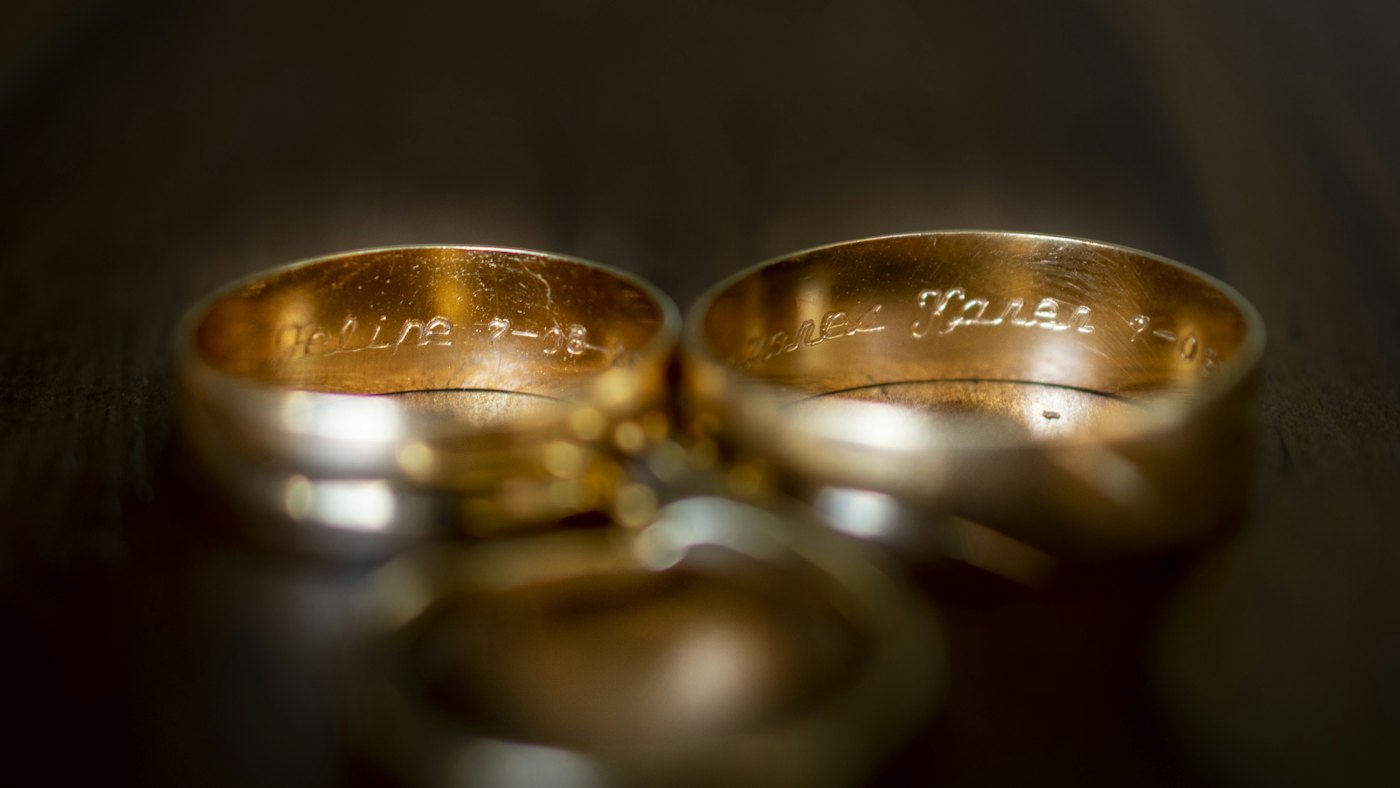
Inside almost every ring are a few tiny stamps. They state how much precious metal the alloy contains and, depending on the country, who made the piece and who tested it.
The fineness: parts per thousand
| Stamp | Meaning |
|---|---|
| 375 | 9 carat gold, 37.5% gold |
| 585 | 14 carat gold, 58.5% gold |
| 750 | 18 carat gold, 75% gold |
| 916 | 22 carat gold, 91.6% gold |
| 800, 835, 925 | silver; 925 is sterling |
| 950 | platinum, 95%; also used for palladium |
In the United States and some other countries the gold content is stamped in karats: 10K, 14K, 18K. Read more in gold: carat and alloys.
Who tests it differs by country
Netherlands. Precious metal must be tested and marked by one of the two independent assay offices. Pieces below 1 gram of gold, 8 grams of silver or 0.5 gram of platinum are exempt. Besides the fineness mark, a piece carries the maker's own registered mark.
United Kingdom. Hallmarking is compulsory above 1 gram for gold and palladium, 7.78 grams for silver and 0.5 gram for platinum. A full hallmark has the sponsor's mark, the fineness, and the symbol of the assay office: a leopard's head for London, an anchor for Birmingham, a rose for Sheffield, a castle for Edinburgh.
France. French marks are pictures. An eagle's head stands for gold of at least 18 carat, a head of Minerva for silver. The maker's mark is lozenge-shaped.
Germany, the United States and many others. There is no compulsory independent test. The maker stamps the fineness on their own responsibility.
Across borders. Countries that joined the international hallmarking convention recognise each other's Common Control Mark: a pair of scales with the fineness in it.
What a stamp does not tell you
A stamp says nothing about the stones. It also does not prove that a piece is solid: stamps such as GP, GF or HGE mean a layer of gold over another metal, see solid, vermeil, gold-filled and plated. Very light pieces and old pieces may carry no stamp at all without anything being wrong. A goldsmith can test the metal.