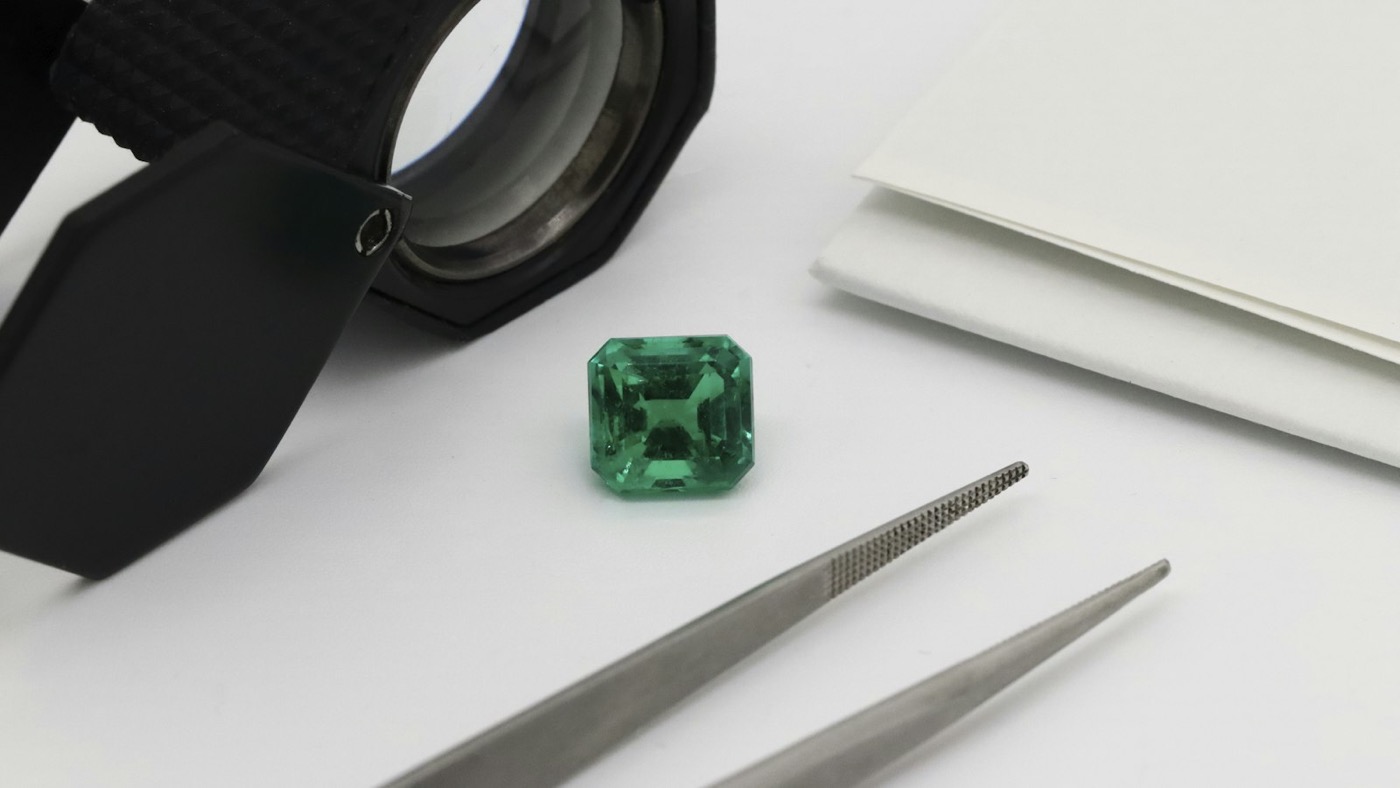
A diamond report grades cut, colour, clarity and carat on scales the whole trade shares. A coloured stone report does something else. For a sapphire, ruby, emerald, spinel or Paraíba tourmaline, the questions that decide the price are whether the stone is natural, what has been done to it, and, for the finest stones, where it was mined. Those are the questions a coloured stone laboratory answers.
The laboratories
Four names come up again and again in auction catalogues and dealers' offices. Each has its own house style, and on a stone of real value it is common to see two of them.
- SSEF, the Swiss Gemmological Institute in Basel, founded in 1974 and run as a non-profit foundation. Known for origin and treatment reports on ruby, sapphire and emerald, and for testing natural pearls.
- Gübelin Gem Lab in Lucerne, which grew out of the Gübelin jewellery house and has been studying inclusions since the 1920s. A Gübelin report with a stated origin carries weight in the trade. Its Provenance Proof programme adds a traceable record from the mine onwards.
- GRS (GemResearch Swisslab), founded in 1996 by Adolf Peretti, with laboratories in Switzerland and Asia. Its reports are common on stones sold in Bangkok and Hong Kong, and it is known for the colour terms it prints, such as "pigeon's blood" for ruby and "royal blue" for sapphire.
- AGL, American Gemological Laboratories in New York, founded in 1977. The reference laboratory of the American coloured stone trade, with a detailed system for describing the degree of enhancement.
GIA also issues coloured stone reports, with origin on request, and is often the name a buyer outside the trade recognises. Read more about diamond reports, which follow different rules.
What a report says
Identification. The species and variety: natural corundum, variety sapphire. This is the line that separates a natural stone from a synthetic one of the same chemistry. Synthetic sapphire and ruby have been made since the nineteenth century and look the part.
Treatment. The single most important line. For sapphire and ruby the usual note is whether the stone shows signs of heating; unheated stones of fine colour are rare and priced accordingly. Beyond heating, the report names anything more invasive: beryllium diffusion, glass filling in ruby, dyeing. For emerald the question is clarity enhancement: nearly every emerald has had its fissures filled with oil or resin, and the report grades how much, typically none, minor, moderate or significant. Read more about heating in the sapphire article and oiling in the emerald article.
Origin. An opinion, not a certainty. Laboratories determine origin by comparing a stone's inclusions, trace elements and spectra with reference stones from known mines. For many stones the result is clear; for some, laboratories disagree, and a report will then say so or leave the origin open. Origin matters because the market pays a premium for Kashmir and Ceylon sapphire, Burmese ruby and Colombian emerald, but a fine stone from Mozambique or Zambia is not a lesser stone. Read more about where gemstones come from.
Colour terms. "Pigeon's blood", "royal blue", "cornflower blue", "Paraíba": trade names for the finest colours, printed by some laboratories when a stone meets their own criteria. The criteria are not identical from one laboratory to the next. A stone that earns the term at one may not at another, which is one reason the same stone sometimes travels with two reports.
What a report does not say
It states no value and no grade for the cut. Two sapphires with identical reports can differ several times in price because one is a livelier, better-cut stone. It also describes the stone on the day of testing: a report on an emerald is silent about oil added later.
When you need one
For an engagement ring with a natural sapphire or ruby of some size, or an emerald of fine colour, a report from one of these laboratories is money well spent, and a goldsmith can arrange it. For small accent stones and for most tourmaline, garnet, aquamarine and spinel under a carat, the cost of the report is out of proportion to the stone; the goldsmith's invoice naming the stone and any treatment is what you keep instead. A piece on Lujoro that carries a report says which laboratory on its page, with a link to check the number.