The hallmarks article explains the system: fineness in parts per thousand, and which countries test their precious metal and which leave it to the maker. This page is the field guide: the marks themselves, one by one, so that you can turn an inherited ring under a loupe and know what you are looking at. Look inside the shank of a ring, on the back of a pendant, on the clasp or the last link of a chain; the marks are small, often worn, and a 10x loupe is the tool.
Reading the marks in order
A fully marked European piece carries up to four things. A fineness mark: a number (585, 750, 925) or a picture that stands for one. A maker's or sponsor's mark: initials or a symbol in a shield or lozenge, registered with the authority. An assay office mark, where the state tests the metal: a picture that names the office. And sometimes a year letter. The order and shapes differ by country, and a piece may carry marks from two countries when it was imported and tested again.
The Netherlands
The Dutch assay offices, WaarborgHolland and Edelmetaal Waarborg Nederland, test and mark everything above 1 gram of gold, 8 grams of silver or 0.5 gram of platinum. The current marks:
- Gold. Large new pieces: a lion with the fineness. 916 (22 carat) is a running lion; 833 (20 carat) a lion in an octagon; 750 (18 carat) a lion holding a sword, with 750; 585 (14 carat) an oak leaf with 585. Small new pieces carry a smaller version: 750 as a tulip-shaped mark with the number, 585 as a small oak leaf, 916 and 833 as small leaf and lozenge shapes. Second-hand pieces tested later get the number alone in an ornamental frame.
- Silver. A lion passant with a Roman numeral: I for 925 (sterling, first standard), II for 835 (second standard), III for 800. Small pieces carry the "little sword", a sword shape with 925 or 835 in it; 800 gets Z800. Tested second-hand silver is marked Z I, Z II or Z.
- Platinum. PT with the fineness, 950, 900 or 850, in an oval or octagon.
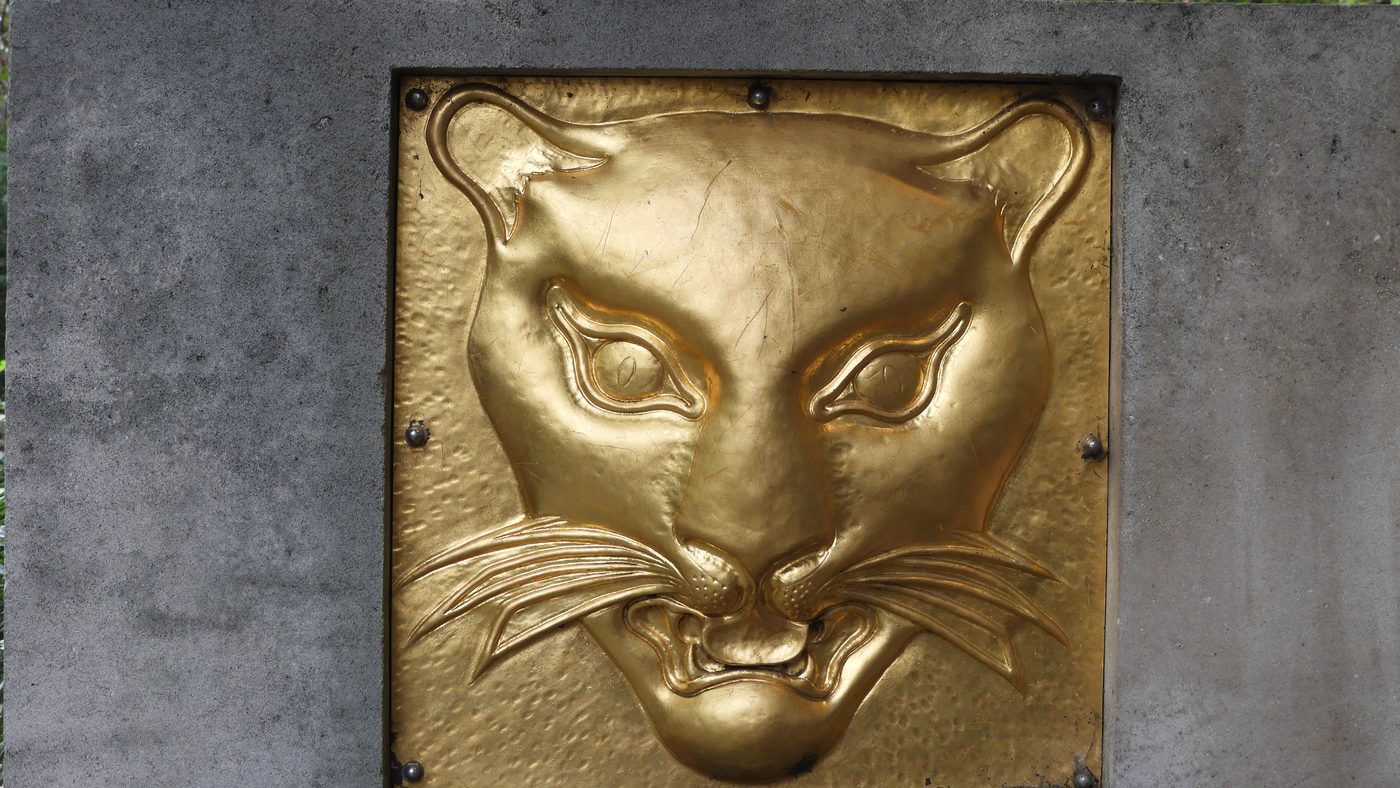
- Assay office marks. A lion's head with WH for WaarborgHolland; a horse's head with NL for Edelmetaal Waarborg Nederland.
- Year letters. A letter in a circle: Q for 2000, then R, S, T through Z for 2009, A for 2010 through O for 2024, P for 2025, Q for 2026. Older Dutch pieces carry earlier office marks and letter cycles; the assay offices publish the tables.
- Maker's mark. The responsibility mark, initials or a symbol registered by the maker or importer; required on every marked piece.
United Kingdom
British hallmarking is compulsory above 1 gram for gold and palladium, 7.78 grams for silver and 0.5 gram for platinum, and only the assay offices may apply it. Three marks are compulsory: the sponsor's mark, initials in a shield; the fineness as a number in a shape that names the metal (a rectangle with cut corners for gold, an oval for silver, a house shape for platinum); and the assay office mark: a leopard's head for London, an anchor for Birmingham, a rose for Sheffield, a castle for Edinburgh. Two optional marks help with dating: the traditional fineness pictures, a crown for gold, the lion passant for sterling silver, the figure of Britannia for 958 silver, an orb for platinum; and the date letter, a letter whose shield and script change each year, read against the office's published table. The London office offers a service to trace a sponsor's mark.
France
French marks are pictures, struck by the state under the customs administration, and a French piece carries two: the maker's mark in a lozenge with initials and a symbol, and the guarantee mark. For gold of 750 that is the eagle's head; 585 gold carries a scallop shell, 375 a clover. For silver it is the head of Minerva, with a small 1 or 2 for the standard. For platinum, a dog's head. Imported and second-hand pieces get their own marks, an owl for gold and a swan for silver. An eagle's head is the single most reliable sign that an old ring is 18 carat.
Germany, Belgium, Switzerland, Italy
Germany has no state hallmark: the maker stamps the fineness number (333, 585, 750) on their own responsibility, and silver from 800 up has carried a crescent moon and crown since 1888. Belgium has no compulsory marking either; a fineness number and a registered maker's mark are what you find. Switzerland marks watch cases and jewellery with the St Bernard dog's head; older Swiss pieces carry a squirrel for 585 gold and the head of Helvetia for 750. Italy stamps the fineness and a maker's registration, a star with a number and a province code such as 1 AR.
The Common Control Mark
Twenty-two countries, the Netherlands and the United Kingdom among them, recognise each other's testing through the Hallmarking Convention. Its mark is a pair of scales with the fineness number inside a shape that names the metal: two intersecting circles for gold, an M-shaped surround for silver, a lozenge for platinum. A piece with this mark can be sold in any member country without a new test.
Marks that are not hallmarks
GP, GEP, HGE, RGP and "1/20 12K GF" mean gold plated, gold electroplated, heavy gold electroplate, rolled gold plate and gold filled: a layer of gold over another metal, see solid, vermeil, gold-filled and plated. "925" on its own, without an assay mark, is the maker's word in countries without state testing, and it is stamped on a great deal of silver-coloured metal that is not silver. "Sterling", "Silver" and "Plat" are claims, not proofs.
What a hallmark does not tell you
Nothing about the stones, nothing about who made the design, and nothing about the metal under a thick plated layer if the piece was marked before plating. A hallmark proves the fineness of the piece as tested; it does not prove the piece is solid throughout, and it says nothing about value beyond the metal. See valuation and insurance.
When the marks are missing or worn
Very light pieces are exempt everywhere, old pieces were often never marked, and a ring that has been resized may have lost its marks with the cut-out piece. A goldsmith tests the metal, with acid on a touchstone or with an X-ray fluorescence meter, and tells you what it is; that is also the first step when an heirloom is being remade. Describe your piece if you want it looked at.