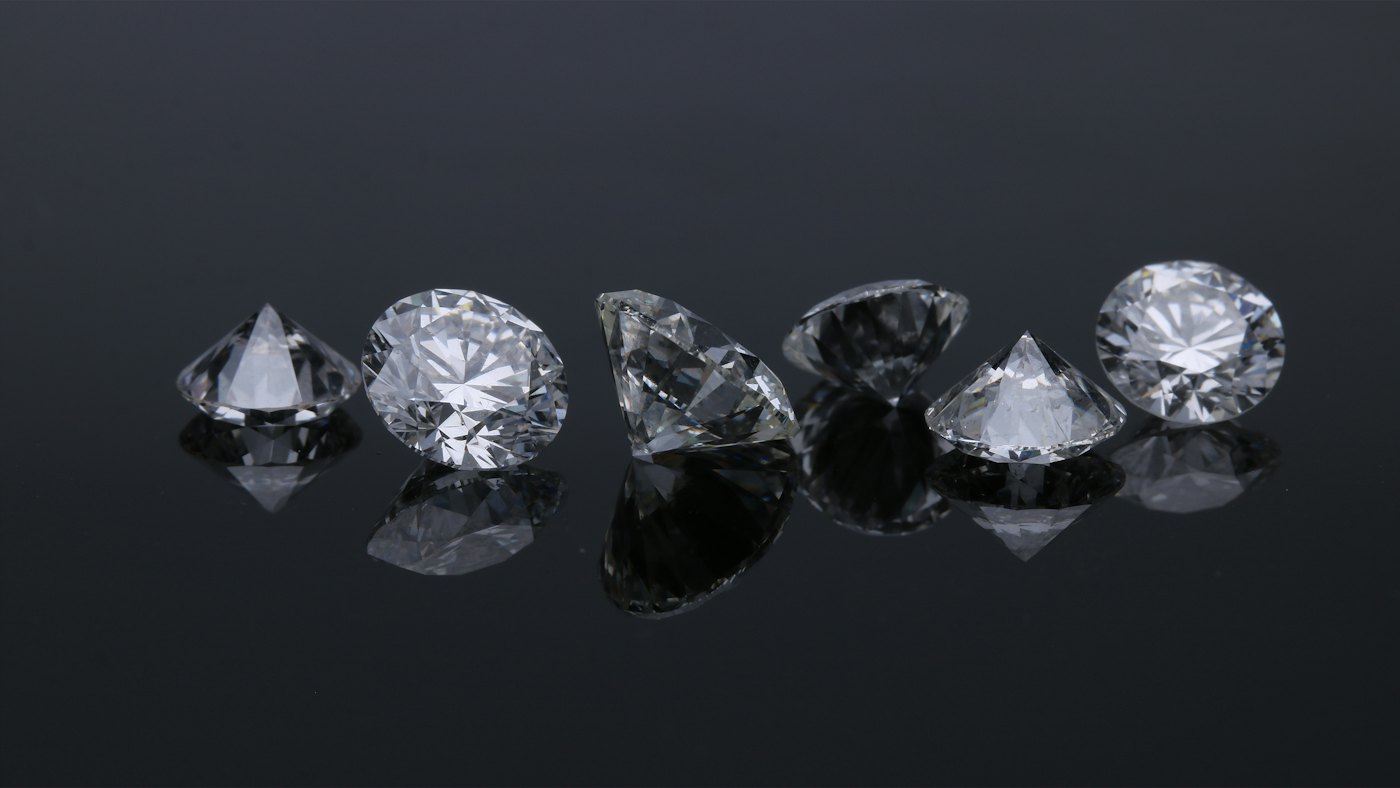
Every diamond is described by four properties, the four Cs. Together they decide the price. They do not weigh equally in what you actually see.
Carat: the weight
Carat is weight, not size. One carat is 0.2 gram. Two stones of the same weight can look different in size, depending on how they are cut. Prices jump at round numbers such as 0.50 and 1.00 carat, so a stone just under such a threshold costs noticeably less and looks the same.
The word comes from the carob seed, which was once used as a counterweight on the scales; the metric carat of 0.2 gram has been the standard since 1907. For a round brilliant, weight and size go together roughly like this:
| Diameter | Weight in carat |
|---|---|
| 2.2 | 0.04 |
| 3.0 | 0.10 |
| 4.1 | 0.25 |
| 5.2 | 0.50 |
| 6.5 | 1.00 |
| 7.4 | 1.50 |
| 8.2 | 2.00 |
| 9.0 | 2.50 |
| 9.3 | 3.00 |
| 11.0 | 5.00 |
The jump from 0.50 to 1.00 carat is only 1.3 mm across, which is why a well-chosen 0.90 carat stone looks nearly the same as a 1.00 carat one and costs much less.
Colour: from D to Z
White diamonds are graded from D (colourless) to Z (clearly tinted yellow or brown). D, E and F are colourless, G to J near colourless. Set in yellow or rose gold, a G, H or I stone looks white to almost everyone. In platinum or white gold a faint tint shows a little sooner.
Clarity: what is inside
Almost every diamond has small inclusions. The scale runs from FL (flawless) and IF through VVS1 and VVS2, VS1 and VS2, SI1 and SI2, to I1, I2 and I3. From about VS2, and often SI1, a stone is "eye clean": you see nothing without a loupe. Paying for more than that is paying for something only a microscope shows.
Cut: what makes it sparkle
Cut is how well the facets are proportioned and finished. It decides how much light comes back to your eye. A well cut stone of a lower colour looks livelier than a poorly cut stone of a high colour. If you have to choose, keep the cut and give way on colour or clarity.
How the trade prices diamonds: the Rapaport list
When a goldsmith or dealer quotes you a diamond, the starting point is almost always the Rapaport Price List, "Rap" for short. It has been published since 1978 and is the benchmark of the diamond trade.
The list is a grid. For each size range it gives a price per carat for every combination of colour and clarity, in US dollars. There is one list for round brilliants and one that serves for the other shapes. Dealers do not pay the list price: they trade at a percentage below it, or occasionally above it for stones in demand. "Twelve back" means twelve percent under Rap.
Three things are worth knowing as a buyer:
- It is a trade list. It is available by subscription to the trade only, so you will not find the current figures in public. What you can do is ask a goldsmith how a quoted stone relates to the list.
- It explains the price jumps. The size ranges begin at round weights such as 0.50, 0.70, 1.00 and 1.50 carat, and the price per carat steps up at each one. That is why a 0.95 carat stone costs noticeably less than a 1.00 carat stone that looks the same.
- It does not cover everything. The list assumes a well-cut stone with a reliable grading report. Cut quality, fluorescence and how attractive the individual stone is all move the real price. It does not cover lab-grown diamonds, which are priced separately and much lower.
Hard, but not unbreakable
Diamond is the hardest gemstone: 10 on the Mohs scale. Nothing in daily life scratches it. It can still chip from a hard knock at the wrong angle, especially at a thin edge or a sharp corner. A good setting protects those places.
In practice
Many goldsmiths in the Netherlands and Belgium buy their diamonds in Antwerp, the diamond capital. Tell the goldsmith your budget and what matters to you: size, whiteness or sparkle. A goldsmith can show you what each choice does to the price. For a larger stone, ask for an independent grading report. Curious about the alternative? Read about lab-grown diamonds, or look at diamond jewellery by independent goldsmiths.