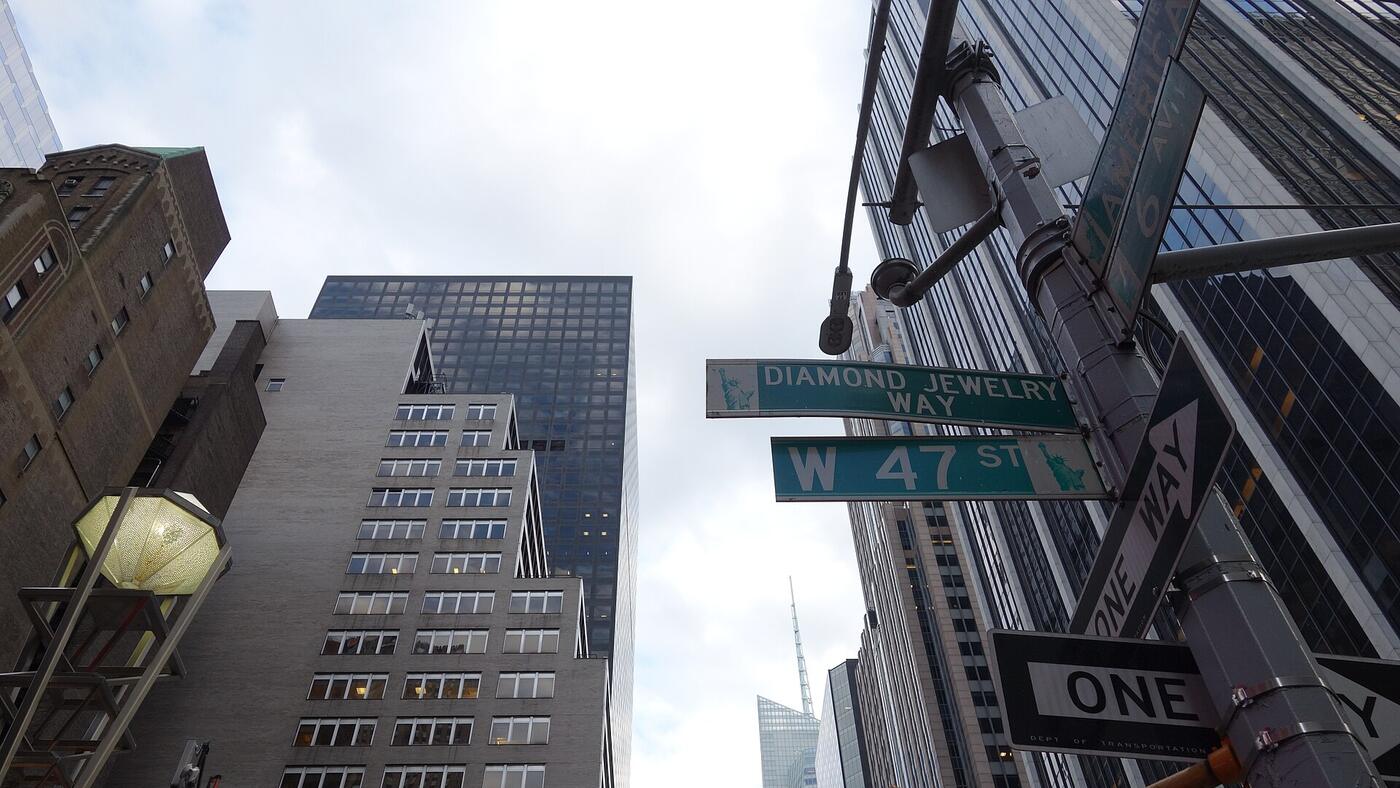
New York's Diamond District is a single block: West 47th Street between Fifth and Sixth Avenue in Midtown Manhattan. The street carries the honorary name Diamond and Jewelry Way, and the lamp posts at its corners are shaped like diamonds. Most of the diamonds that enter the United States pass through this block at some point.
How the block works
Thousands of businesses operate on the street, most of them invisible from the pavement. At street level are the exchanges: large halls in which dozens of independent dealers each rent a booth. Above them, behind security, are the offices of wholesalers, cutters, setters, polishers and repair workshops. A ring can be designed, cast, set and polished without ever leaving the block.
The trade's own institutions are here too: the Diamond Dealers Club, founded in 1931, where members trade among themselves, and a laboratory of the GIA, see diamond grading reports. Deals between dealers are traditionally closed with a handshake and the words "mazal u'bracha", luck and blessing, a custom shared with Antwerp and the rest of the diamond world.
How it got there
New York's jewellery trade began downtown, around Maiden Lane and later the Bowery and Canal Street. It moved uptown to 47th Street in the 1920s and 1930s. The district grew quickly during and after the Second World War, when Jewish diamond dealers and cutters who fled Antwerp and Amsterdam settled in New York and rebuilt their businesses here.
Buying on 47th Street
The block can be overwhelming, and that is partly by design. A few things to know:
- Ignore the hawkers. Men on the pavement will try to steer you into a particular exchange. They work on commission. Decide for yourself where you go.
- Prices are negotiable. The first price is an opening bid. Dealers expect you to compare and to bargain.
- A stone is not cheaper because it is sold here. The whole trade prices from the same list, see how the trade prices diamonds. What the district offers is choice and competition, not a secret discount.
- Insist on a GIA report for any diamond of some size, and check the report number on the GIA website and against the inscription on the stone. Be careful with reports from laboratories you have never heard of.
- Get everything in writing: a receipt that describes the stone fully, states the report number, and sets out the return policy.
- Have it valued independently for insurance, by someone who is not the seller, see valuation and insurance.
The other route
Many independent goldsmiths and jewellers in the north-eastern United States buy their stones from dealers on 47th Street they have known for years. They can call in several stones, show you the differences, and set the one you choose in a ring made for you. Describe your piece and mention your budget for the stone.
See the goldsmiths in New York on Lujoro.