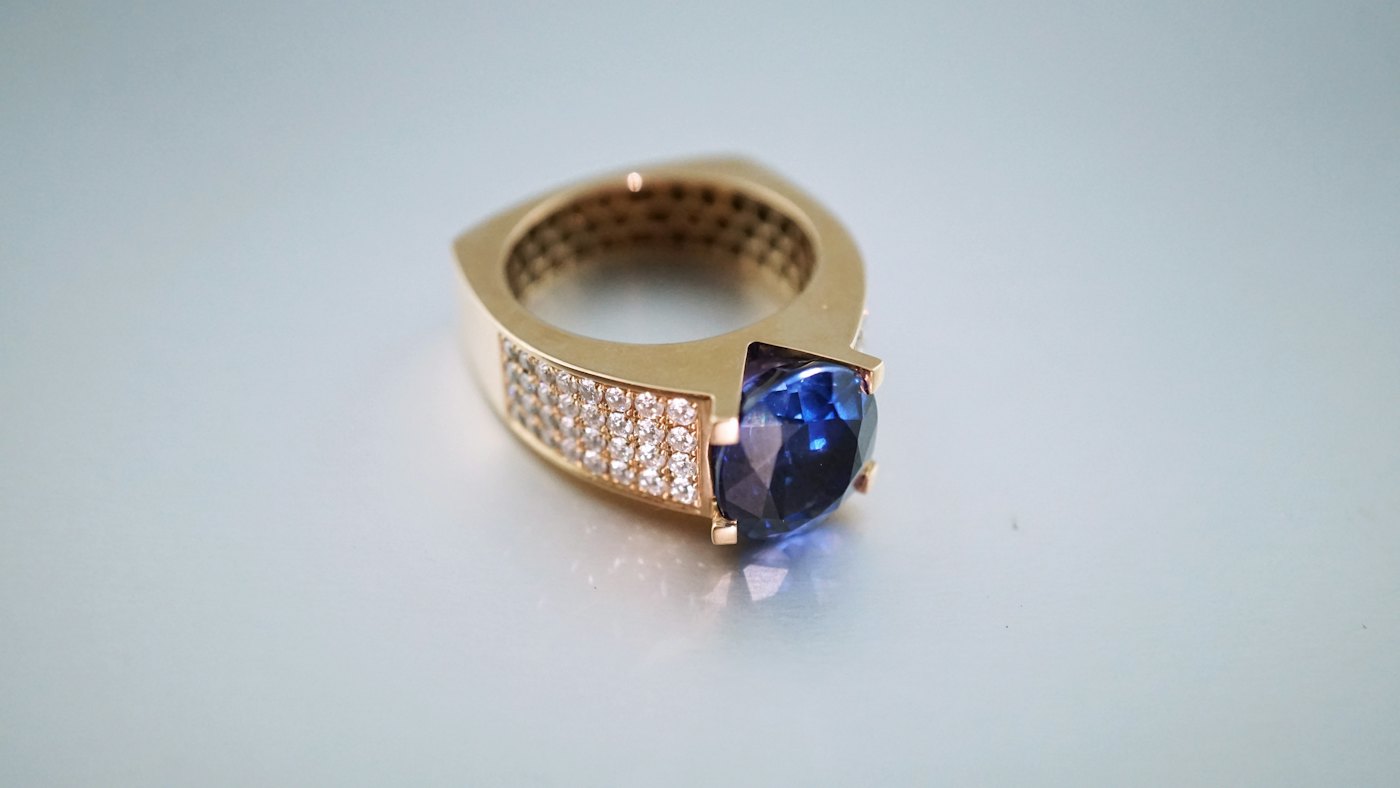
Many goldsmiths now design part of their work on a computer. The design is drawn in 3D, printed as a model in wax or castable resin, and then cast in metal in the traditional way, see lost-wax casting. The printer replaces the hand-carved wax, not the goldsmith: everything after the casting is the same bench work it always was.
What gets printed
Not the jewellery. What comes out of the printer is a model in wax or resin, which is invested, burnt out and cast in gold, silver or platinum. Direct metal printing of precious metal exists but is rare and expensive, and a "3D printed gold ring" almost always means a printed wax cast in gold. Printed resin jewellery, worn as resin, is a different thing altogether, cheap and not a goldsmith's product.
What it is good at
You see it first. A goldsmith can send you realistic images of the design from every angle, and adjust proportions, stone size or band width before any metal is used. For a commission at a distance that is a real advantage, and it is why many Lujoro commissions start with a rendering.
Precision. Settings for many small stones, exact symmetry, a ring that has to fit precisely against an existing one, lettering, geometric patterns: these are easier to get right digitally than by carving wax by hand.
Repeating and resizing. A design can be made again in another size or with another stone without starting over, which matters for a pair of wedding rings or a piece that will be ordered again.
What it does not replace
The printed model is only the beginning. The casting still has to be cleaned, assembled, set and polished by hand, and that finishing decides the quality of the piece; a poorly finished casting from a perfect file is a poor ring. A design that looks good on screen also has to be sound as an object: thick enough where it wears, with claws that hold, with a shank that will survive resizing. That judgement comes from bench experience, not from the software, and it is the difference between a goldsmith who uses CAD and a designer who only draws.
Hand or computer
Neither is better. Hand-carved wax and forged work have a liveliness and a subtle asymmetry that is hard to draw. Digital design is strong in precision and in showing you the result in advance. Many pieces combine them: a printed setting on a hand-forged band, for example, or a hand-carved wax scanned and mirrored for a matching pair. If it matters to you how a piece is made, ask. A good goldsmith will tell you without hesitation, and on Lujoro the technique is stated on the piece.
What it means for the price
CAD saves time on complex geometry and repeats, and costs time on the drawing; for a one-off simple band it is no cheaper than forging, for a pavé setting with sixty stones it is much cheaper than carving. The rendering you get in advance is worth having on any commission where you cannot sit at the bench.