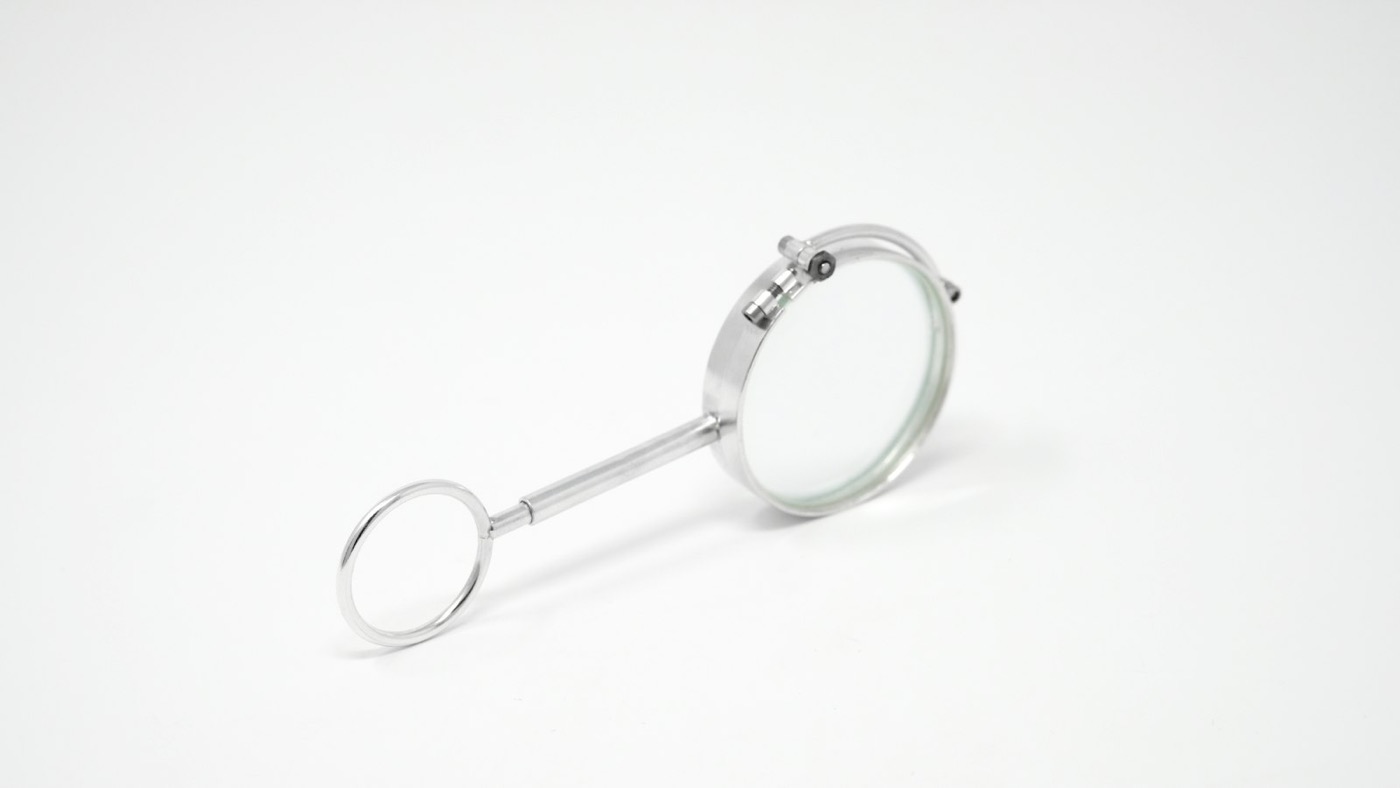
Every stone article on Lujoro carries a card with hardness, specific gravity, refractive index and crystal system. Those figures are not decoration: they are what a gemmologist measures to say what a stone is. Most of the measuring is done on a bench with instruments that fit in a drawer, without touching a facet. Here is what they are and what each one settles. For the figures themselves, see reading the properties card.
The loupe
A 10x loupe is where every examination starts and where many end. Inside a natural stone are crystals of other minerals, needles, healed fractures, colour zoning in straight bands; inside a flame-fusion synthetic are curved lines and round bubbles; inside glass are swirls. A loupe also shows doubling of the back facets in strongly birefringent stones such as zircon and peridot, and chips and abrasions that tell of hardness and age. A microscope shows the same at 20 to 60 times, with better light.
Refractometer
The most useful single instrument. The stone is laid facet-down on a glass prism with a drop of contact liquid, and a scale shows how strongly the stone bends light: its refractive index. Every mineral has its own value or range. Corundum reads 1.76 to 1.77, quartz 1.54 to 1.55, glass anywhere. The instrument also shows birefringence, the difference between a stone's two refractive indices, which separates singly refractive stones (diamond, garnet, spinel, glass) from doubly refractive ones (nearly everything else). A ruby and a red spinel, alike to the eye, are settled in a minute here.
Polariscope and dichroscope
Two simple tools for the same question. Between crossed polarising filters a singly refractive stone stays dark as it turns, a doubly refractive one lights up and darkens four times a turn. The dichroscope, a small tube with a calcite prism, shows the two or three colours a doubly refractive stone transmits in different directions: pleochroism. Iolite shows violet and near colourless, ruby shows purplish red and orange red; garnet and spinel, singly refractive, show one colour only. See optical effects.
Spectroscope
A stone absorbs some wavelengths and passes others, and the pattern of dark lines and bands in its spectrum names the colouring element. Chromium gives ruby, emerald and alexandrite their characteristic lines; iron marks sapphire and peridot; rare-earth lines betray a synthetic garnet. A hand spectroscope shows it by eye; a laboratory does it with a spectrometer and far more precision.
Specific gravity
How heavy a stone is for its size. The classic method is the hydrostatic balance: the stone is weighed in air and in water, and the ratio gives the density. Quicker is a set of heavy liquids of known density: a stone sinks or floats. Diamond is 3.52, its imitation cubic zirconia 5.6 to 6.0, so a loose "diamond" that feels heavy for its size is suspect at once. Only for unmounted stones.
Ultraviolet lamp and colour filters
Under long-wave and short-wave ultraviolet many stones fluoresce, and how they do it is a clue: many diamonds glow blue, ruby glows red, most glass does not glow at all. The Chelsea filter, developed in the 1930s for emerald, makes chromium-coloured stones look red and separated emerald from its imitations of the time; it is still used for a first look.
Hardness: not on a cut stone
The Mohs scale is the figure everyone knows, and the one a gemmologist uses least. Scratching a stone damages it, so hardness pencils are used only on rough or on an inconspicuous spot, and never on a customer's piece. Hardness is inferred from the identification, not tested. See which gemstones can be worn every day.
Diamond testers
A thermal tester measures how fast heat flows through the stone; diamond conducts heat far better than glass or cubic zirconia. Moissanite conducts heat too and passes, so a second, electrical tester or a loupe (moissanite shows doubled facet edges) is needed. Neither tester tells a natural diamond from a lab-grown one; that takes a laboratory.
Where the laboratory begins
A goldsmith or a trained gemmologist can say what a stone is and often whether it is natural or synthetic. Three questions need more: whether a lab-grown diamond or a top-quality synthetic is natural, whether a sapphire has been heated, and where a stone was mined. Those take spectrometers, chemical analysis of trace elements and reference collections, and are the work of gemmological laboratories. For a stone of value, that report is what you ask for; for the rest, a goldsmith's identification and invoice is the right level.