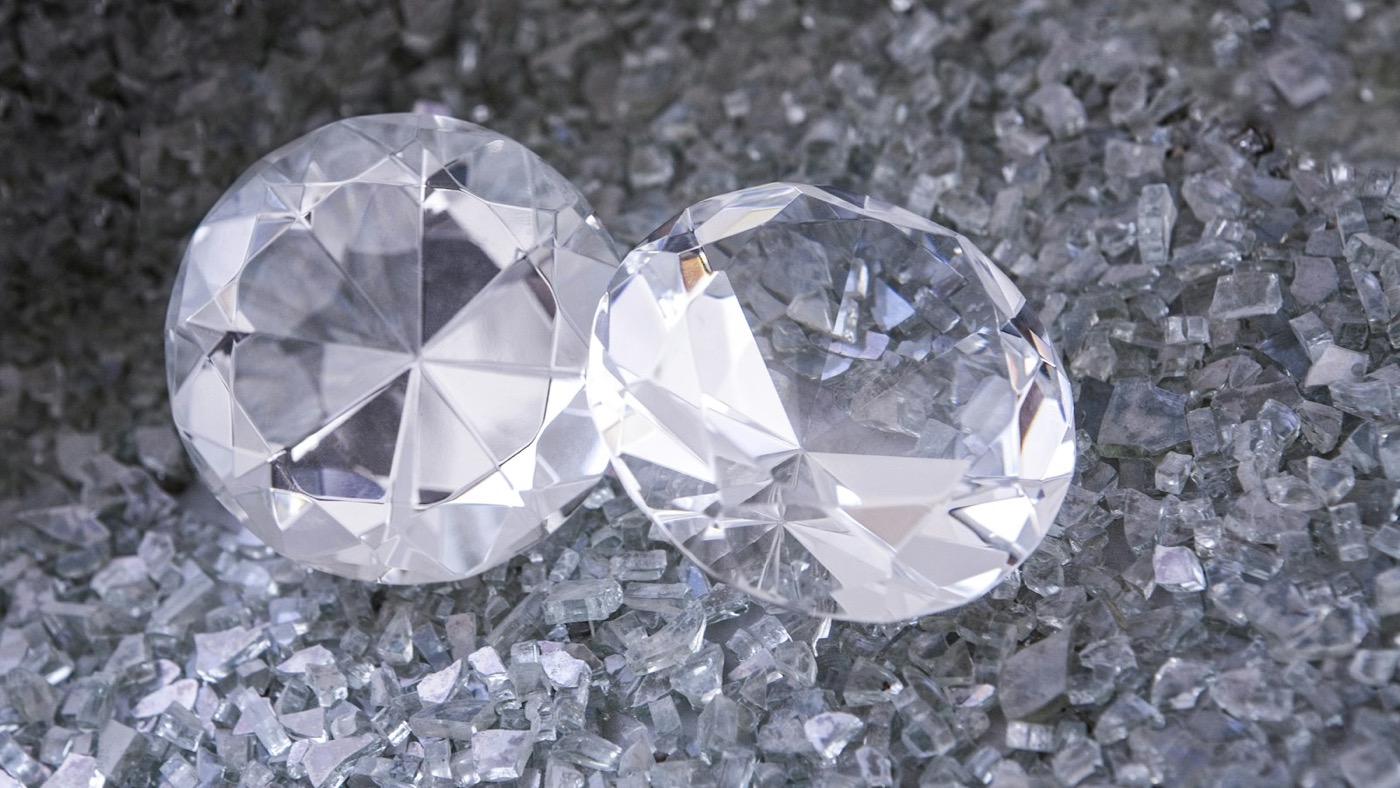
"Is it real?" is the wrong question, because a synthetic ruby is a real ruby in every chemical and physical sense. The right questions are: is it natural or made, is it what its name says, and is it one piece. The trade has a word for each answer, and the rules say which word must be used.
Three different things
Synthetic (also laboratory-grown, laboratory-created, man-made): the same mineral as the natural stone, grown by people. Synthetic sapphire is corundum, synthetic emerald is beryl, a lab-grown diamond is diamond. Same hardness, same colour, same brilliance; only the origin and the price differ.
Imitation (also simulant): a different material that looks like the stone. Glass, cubic zirconia, synthetic spinel coloured to pass for aquamarine, dyed quartz sold as something else. An imitation may itself be synthetic, as cubic zirconia is, but it is not the stone it imitates.
Assembled (composite): two or more pieces joined together. A doublet is two parts, a triplet three. Sometimes honest and useful, as with opal doublets that make thin opal wearable; sometimes made to deceive.
Treatments, such as heating a sapphire or oiling an emerald, are a fourth subject: the stone is natural, but something was done to it. See coloured stone reports.
How synthetic stones are grown
The first method still in use is flame fusion, presented by Auguste Verneuil in 1902: powdered alumina falls through a flame and crystallises on a rod into a carrot-shaped boule. Cheap, fast, and the source of nearly all synthetic ruby, sapphire and spinel in watches, costume jewellery and old rings. Flux growth and hydrothermal growth, developed from the 1930s onwards, grow crystals slowly in a molten salt or in hot water under pressure; they produce synthetic emerald, ruby and quartz that look far more natural and cost far more. Diamond is grown under high pressure and temperature (HPHT) or deposited from gas (CVD).
The common imitations
- Glass, called paste or strass after the eighteenth-century Parisian jeweller Georg Friedrich Strass: imitates every stone. Warm to the touch, often with bubbles and swirls inside, rounded facet edges, chips with a shell-like fracture.
- Cubic zirconia (CZ), commercial since 1976: the standard diamond imitation, heavier than diamond and with more fire. Read more about zircon and cubic zirconia.
- Moissanite: silicon carbide, close to diamond in hardness, with a stronger fire; sold under its own name, which makes it a stone in its own right rather than a fake.
- YAG and GGG, synthetic garnets of the 1960s and 1970s, the diamond imitations before cubic zirconia; still found in rings from those years.
- Synthetic spinel by flame fusion, coloured to imitate aquamarine, blue zircon, peridot, even diamond; extremely common in mid-century jewellery.
- Dyed and reconstituted stones: howlite dyed as turquoise, quartz dyed as lapis, crushed turquoise bonded with resin.
Assembled stones
The garnet-topped doublet, a thin slice of red garnet fused to coloured glass, was the standard cheap "gem" of the Victorian and Edwardian trade and turns up in heirlooms; the garnet layer takes the wear and the glass gives the colour, green, blue or red. Opal doublets and triplets back a thin slice of precious opal with dark stone and, in a triplet, cap it with clear quartz. Sapphire doublets combine a natural crown with a synthetic pavilion so the top looks right under a loupe. Emerald "soudé" is two pieces of colourless quartz or beryl with green cement in between. Immersed in water and viewed from the side, a join at the girdle is usually plain to see.
What the seller must say
CIBJO, the world jewellery federation, requires that a made stone is always called synthetic, laboratory-grown or an equivalent term next to its name, that an imitation is called an imitation, and that assembled stones are described as such. "Cultured" is reserved for pearls. In the European Union, selling a synthetic or an imitation as a natural stone is an unfair commercial practice, and the same goes for misleading trade names. A goldsmith's invoice names what was set.
How they are told apart
A 10x loupe shows most flame-fusion stones by their curved growth lines and round gas bubbles; natural stones grow in straight lines and hold angular crystals, needles and healed fractures. Flux-grown stones show wispy veils of flux, hydrothermal ones a chevron pattern. Glass has bubbles and swirls and is singly refractive; a polariscope or a refractometer settles it. Cubic zirconia fails a thermal diamond tester; moissanite passes it and needs an electrical tester or a look at its doubled facet edges. Modern lab-grown diamonds and the best flux and hydrothermal stones cannot be told apart with a loupe: for those, a laboratory with spectroscopy is the only certainty, and any diamond of size should come with a report. Read more about how a gemmologist identifies a stone.
What it means for a commission
There is nothing wrong with a synthetic stone in a piece of jewellery, provided you know and paid accordingly. A synthetic sapphire in a design where the colour matters more than the provenance is a sensible choice; a lab-grown diamond is a common one. What you should not do is pay natural prices for made stones, and what you keep is the invoice that names them. A goldsmith on Lujoro states on the piece whether a stone is natural, lab-grown or treated.