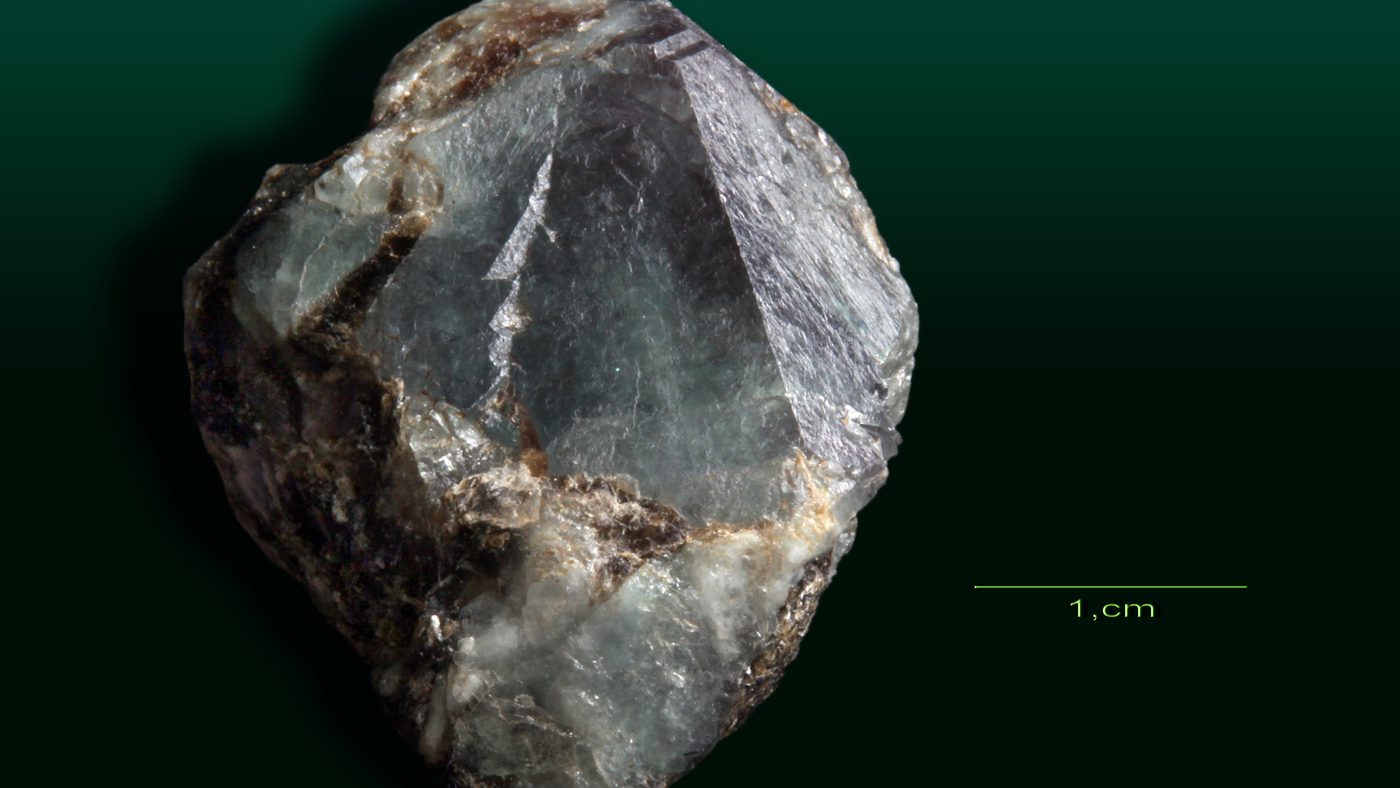
Alexandrite is the variety of chrysoberyl that changes colour: green to blue-green in daylight, red to purplish red under an incandescent bulb or a candle. The old trade line is "emerald by day, ruby by night", and for a fine stone it is barely an exaggeration. No other stone does this as strongly, and no other stone of its quality is as rare. Read more about the mineral itself in chrysoberyl and cat's eye.
Why it changes colour
The colour comes from chromium, the same element that colours emerald and ruby. Alexandrite absorbs light in the yellow part of the spectrum and transmits both green and red about equally, so the light source decides which the eye sees: daylight is rich in green and blue, a bulb or a flame in red. The effect is measured by how complete the change is. A weak stone shifts from greyish green to brownish red; a fine stone switches from a clear green to a raspberry red, with little of the other colour left. Judge it under both lights, ideally daylight from a north window and an ordinary incandescent bulb; LED lamps show less of the change. See optical effects.
Where it comes from
It was found in the emerald mines of the Ural mountains in the 1830s and named after the future Tsar Alexander II. The Russian stones, green and red being the colours of the imperial army, became the benchmark, and the Ural deposits are all but exhausted; a Russian alexandrite today is nearly always an antique. Brazil produced the finest stones of the modern era from the Hematita deposit in Minas Gerais, discovered in 1987 and largely worked out within a few years. Sri Lanka yields larger but usually weaker-changing stones; Tanzania, Madagascar, Zimbabwe and India supply most of the market now. Origin does not decide the price the way it does for sapphire; the strength of the change does.
What decides the price
Three things, in this order: the strength and cleanness of the colour change, clarity, and size. Fine alexandrite is rare above one carat and very rare above three, and a clean stone with a full change is priced with the costliest coloured stones. Stones with a weak or muddy change, or a strong green with a brown night colour, cost a fraction. Cat's eye alexandrite, with a moving line of light on top of the colour change, is rarer still and valued accordingly.
Synthetic and imitation
Synthetic alexandrite has been grown since the 1970s by flux and pulling methods and is common; it shows a good change and can be hard to tell from natural stone without a laboratory. Far commoner is "alexandrite" that is not chrysoberyl at all: synthetic corundum or spinel with a colour change, sold by that name since the early twentieth century and found in countless mid-century rings. A laboratory report naming the species and its origin (natural or synthetic) is the rule for any alexandrite of value. Read more about synthetic and imitation stones.
Wearing it
At 8.5 on the Mohs scale, alexandrite is harder than every stone except diamond, sapphire and ruby, with no cleavage to worry about. It is a stone for a ring worn every day. See which gemstones can be worn every day.
Alexandrite is a birthstone for June, beside pearl and moonstone, and the stone of the fifty-fifth wedding anniversary. Describe your piece and a goldsmith can source a stone and show you its change before it is set.