Feldspar is the most common mineral family in the earth's crust, and four of its members are gemstones: moonstone, labradorite, amazonite and sunstone. The first two are prized for a sheen; these two are prized for colour and glitter.
Amazonite
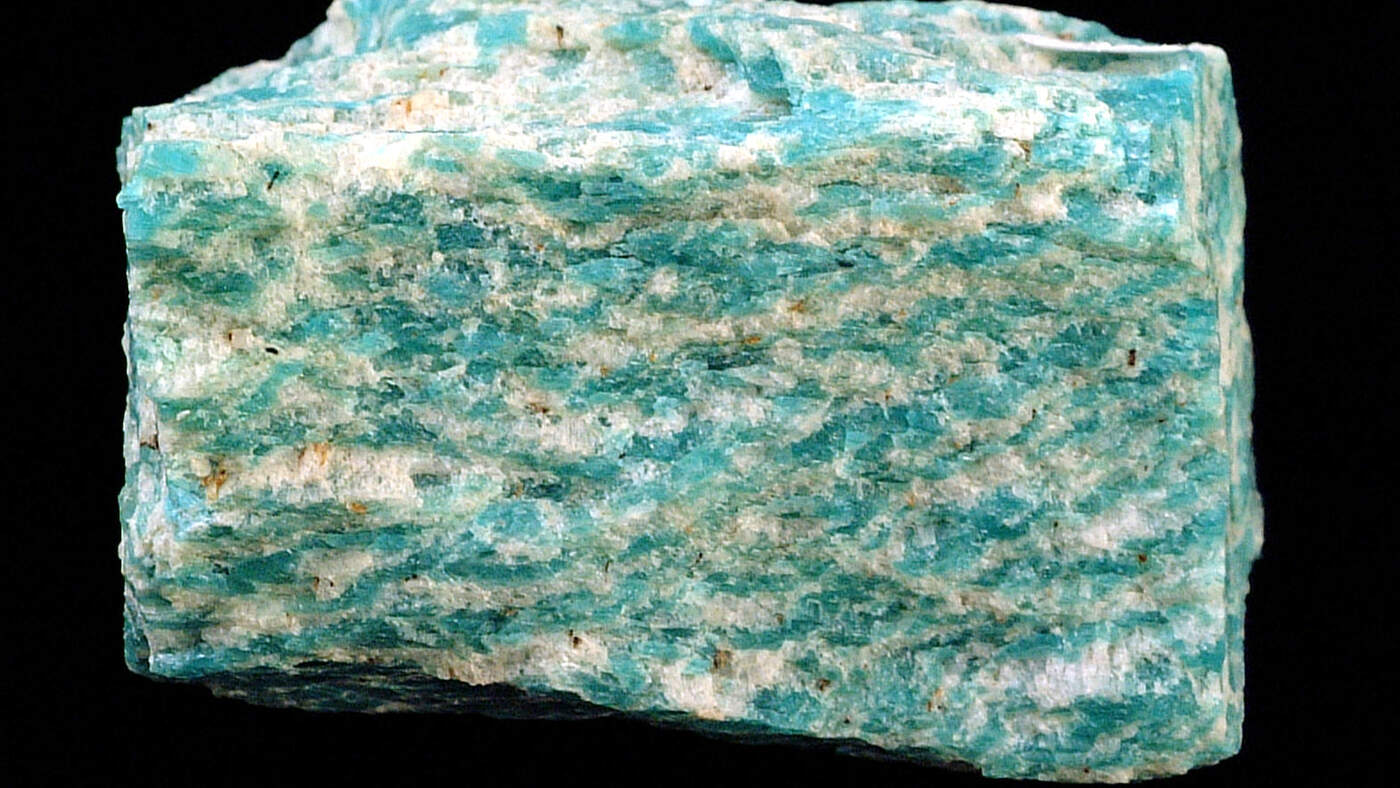
Amazonite is an opaque to translucent blue-green to turquoise variety of the feldspar microcline, often with white streaks or a fine grid of pale lines. Despite the name it does not come from the Amazon: the green stones once reported from the river were probably nephrite, and the name stuck to the wrong mineral. Its colour is caused by traces of lead together with water in the crystal, and it holds up in light.
The classic source is Pikes Peak in Colorado, where amazonite grows beside smoky quartz in specimens that mineral collectors pay well for; the Ilmen mountains in the Urals, Madagascar, Brazil, Ethiopia and Peru supply cutting material. Value follows the saturation of the blue-green and the absence of white: an even turquoise-coloured stone is worth several times a pale, streaky one. Amazonite is cut as cabochons, beads, flat plates and carvings and is affordable in large pieces. It is not treated. Dyed quartzite and howlite are sold as imitations; amazonite shows its characteristic fine white grid where they show none.
Sunstone
Sunstone is feldspar with tiny flat inclusions of copper or hematite that glitter orange, gold or red as the stone moves; the effect is called aventurescence, and it is the same effect in aventurine quartz. Most sunstone, from India, Norway and Tanzania, is translucent, cut as cabochons and cheap. Oregon sunstone is different: transparent feldspar coloured by copper, in orange, red, green and bicolours, with or without the copper glitter, mined in the high desert of southern Oregon and faceted like any transparent gem. It is Oregon's state gemstone, and red and green stones with strong colour are collector's stones at prices that surprise people who know only the cabochon kind. Oregon sunstone is not treated; some copper-bearing feldspar from elsewhere has been diffusion-treated to imitate it, which a laboratory can detect. See optical effects.
Goldstone, the glittering copper-brown material in cheap jewellery, is glass with copper crystals and not a sunstone at all, though it is sold as one.
Wearing them
Both have a hardness of 6 to 6.5 and, like all feldspars, two cleavage directions along which a hard knock can split them. They suit earrings, pendants and rings in a protective setting; a bezel is wise for a ring worn often. Clean with warm water and a soft cloth; no ultrasonic cleaner, no steam. See which stones can be worn every day. Describe your piece and a goldsmith can source either stone in the colour you want.