Some stones are bought for their colour, others for what happens when you move them. A moving line of light, a star, a sheen that rises from inside, a colour that changes with the lamp. Gemmologists call these phenomena, and each has a name, a cause and a handful of stones known for it. The effect nearly always decides how the stone is cut: most are cut as a cabochon with a domed top, because facets would break the effect up.
Cat's eye (chatoyancy)
A single bright line across the stone, which glides as you turn it, like the slit pupil of a cat. It comes from thousands of parallel needles or hollow tubes inside the stone; the cabochon is cut with its base parallel to them, so the light reflects off them in one band. Said without a mineral name, "cat's eye" means chrysoberyl cat's eye, the finest and costliest; the best show a sharp eye that opens and closes as the stone turns. Cat's eyes also occur in quartz, tourmaline, apatite, aquamarine, scapolite and moonstone, and tiger's eye and hawk's eye are the same effect in fibrous quartz. Look for a straight, narrow eye centred on the stone; a broad, blurry one is worth less.
Star (asterism)
Two or three sets of needles crossing at angles give a star instead of a line: six rays in star sapphire and star ruby, where fine rutile needles cross at 60 degrees; four rays in star garnet and star diopside; occasionally twelve. A good star has straight, evenly bright rays that meet in the centre of the dome and move as one when the stone tilts. Star sapphires are usually milky, because the same needles that make the star cloud the stone; a star in a transparent, well-coloured stone is rare. Synthetic star sapphires and rubies have been made since 1947; their stars are often too perfect and sit right at the surface.
Colour change
A stone that is green in daylight and red under a lamp is the classic alexandrite. Daylight is rich in blue and green, incandescent light in red, and a stone that transmits both about equally lets the light source decide. Colour-change garnet, sapphire, spinel and fluorite exist as well. Assess it under both lights, ideally daylight from a north window and an ordinary bulb; LED lamps give less of a change. The trade also calls this "changeant".
Adularescence and labradorescence
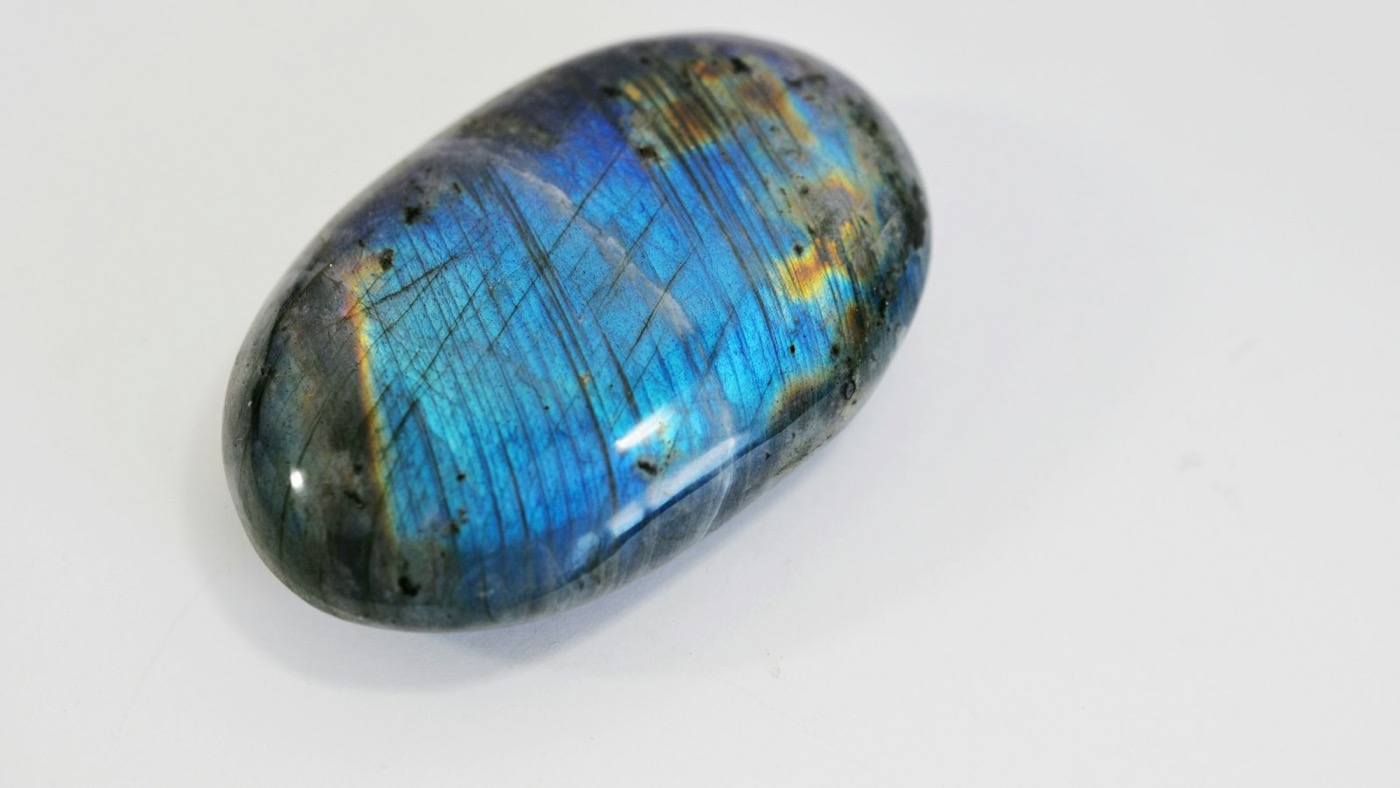
The blue sheen that rises from a moonstone as you turn it is adularescence, named after adularia, the feldspar it occurs in. Very thin alternating layers inside the stone scatter blue light. The finest moonstone is nearly transparent with a blue sheen; white and milky stones are commoner and cheaper. Labradorite does the same with a whole spectrum, blue, green, gold and copper, in broad flashes: labradorescence. Both are cut as cabochons oriented so the sheen faces the dome.
Aventurescence
The glitter of aventurine quartz and sunstone comes from flat flakes of another mineral inside the stone, green fuchsite mica in aventurine, copper or hematite in sunstone, each reflecting a spark of light. It is also the origin of aventurine glass, or goldstone, which is the imitation.
Play of colour and iridescence
Opal shows patches of spectral colour that shift as it moves: play of colour, caused by a regular stacking of minute silica spheres that diffracts light. It is not the same as opalescence, the milky sheen of common opal. Iridescence is the rainbow film on fire agate, ammolite, the inside of a shell and the surface of a fine pearl, where the trade calls it orient. All of these are caused by light interfering in thin layers, the same reason a soap bubble has colour.
Fire
The flashes of spectral colour in a diamond are dispersion: the stone splits white light into its colours, and a good cut sends them back to the eye. Diamond, zircon, demantoid garnet, sphene and moissanite have high dispersion; the figure is on the properties card of the stone articles.
Silk and pleochroism
Two effects that matter more to the gemmologist than to the wearer. Silk is the fine sheen of tiny needle inclusions in sapphire and ruby, the same needles that make a star; intact silk tells the laboratory a stone has not been strongly heated. Pleochroism is a stone showing two or three colours depending on the direction you look through it: iolite goes from violet-blue to almost colourless, tanzanite from blue to violet, kunzite and tourmaline vary as well. The cutter chooses the orientation that puts the best colour face up.
What to look for when buying
Ask for the stone to be shown under a single light source, a small lamp or a torch: a cat's eye or star only appears under one point of light and washes out under diffuse light. Check that the eye or star is centred and moves with the stone. Ask whether it is natural or synthetic; both exist for star corundum and cat's eye chrysoberyl, and glass fibre-optic cat's eyes in bright colours are sold as tumbled stones. For a stone of value, a laboratory report names the species and any treatment.