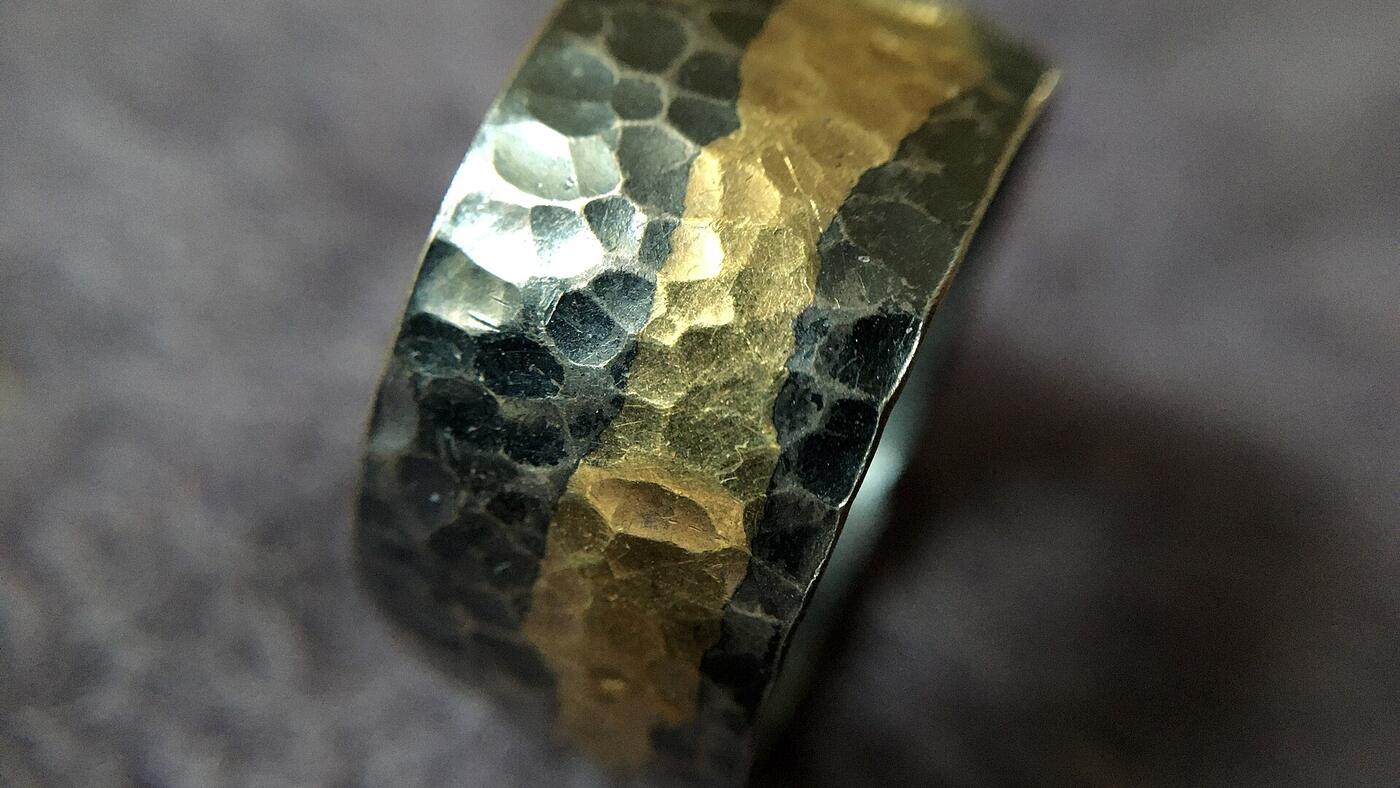
Keum-boo is a Korean technique for applying pure gold to silver. The name means "attached gold". A thin foil of 24 carat gold is laid on the silver, the piece is heated, and the goldsmith presses the foil down with a polished steel or agate burnisher. At the right temperature the two metals bond permanently, atom to atom, without solder. It has been used in Korea for centuries and was taken up by Western studio goldsmiths in the 1980s; it is now a standard technique for gold-on-silver work.
How it works
Pure gold and pure silver bond to each other by diffusion at a temperature well below their melting points, around 300 to 350 degrees, as long as both surfaces are perfectly clean and pressed together. With sterling silver, which contains copper, the goldsmith first heats and pickles the piece several times. Each cycle brings fine silver to the surface and removes the copper oxide, leaving a skin of pure silver for the gold to bond to; this "depletion gilding" is why keum-boo on sterling looks white around the gold.
The foil is thicker than gold leaf, typically a few hundredths of a millimetre, but still very thin, thin enough to cut with scissors or a knife. Shapes are cut, placed on the warm silver and burnished on, and the burnishing tool must move steadily or the foil wrinkles and tears.
How it differs from gold plating
Plating deposits a very thin layer of gold, measured in microns, over a whole surface by electricity, and that layer wears through in time, see solid, vermeil, gold-filled and plated. Keum-boo is a far thicker layer, placed by hand exactly where the maker wants it, as a pattern, a shape or a line. It is a design technique, not a way of making silver look like gold, and a keum-boo piece is silver jewellery with gold on it, which is how it should be described and hallmarked.
The look
Keum-boo is almost always used for contrast: bright yellow 24 carat gold against silver that is left white, brushed matt, or darkened with a patina. Against blackened silver the gold seems to glow, and because the foil is pure gold, it has the deep colour that alloys never quite reach. The technique suits flat and gently curved surfaces best: pendants, earrings, cuffs, the flat top of a ring.
Wear
The bond is permanent; the gold does not peel. But the gold is thin and pure, and so it is soft. On raised areas of a ring that rub constantly it will slowly wear down over years, and a worn patch can be reapplied. In recessed areas, and on earrings, pendants and brooches, it lasts for decades. Clean with warm water and a soft cloth; do not polish keum-boo with abrasive cloths or silver polish, which take the gold off.
See keum-boo jewellery, or describe your piece.