Neither is a stone for a ring worn every day, but both appear in jewellery for their colour, and both are sold at prices that make a large stone possible. What they ask in return is a protective setting and a gentle hand.
Apatite
Apatite is the mineral your teeth and bones are made of, a calcium phosphate, and as a gem it comes in a neon blue-green from Madagascar that looks like Paraíba tourmaline at a hundredth of the price, in yellow, green, violet, brown and a cat's eye variety. Brazil, Mexico, Myanmar and Kenya produce it too. The blue-green is the colour buyers want, and an even, saturated stone without the usual fine needles and cracks is the scarce part; clean stones above a few carats are uncommon. It has a hardness of 5 and is brittle, so it belongs in earrings, pendants and rings worn with care. Heat can change the colour and ultrasonic cleaners can crack it. Apatite is not usually treated; some blue material is heated.
Fluorite
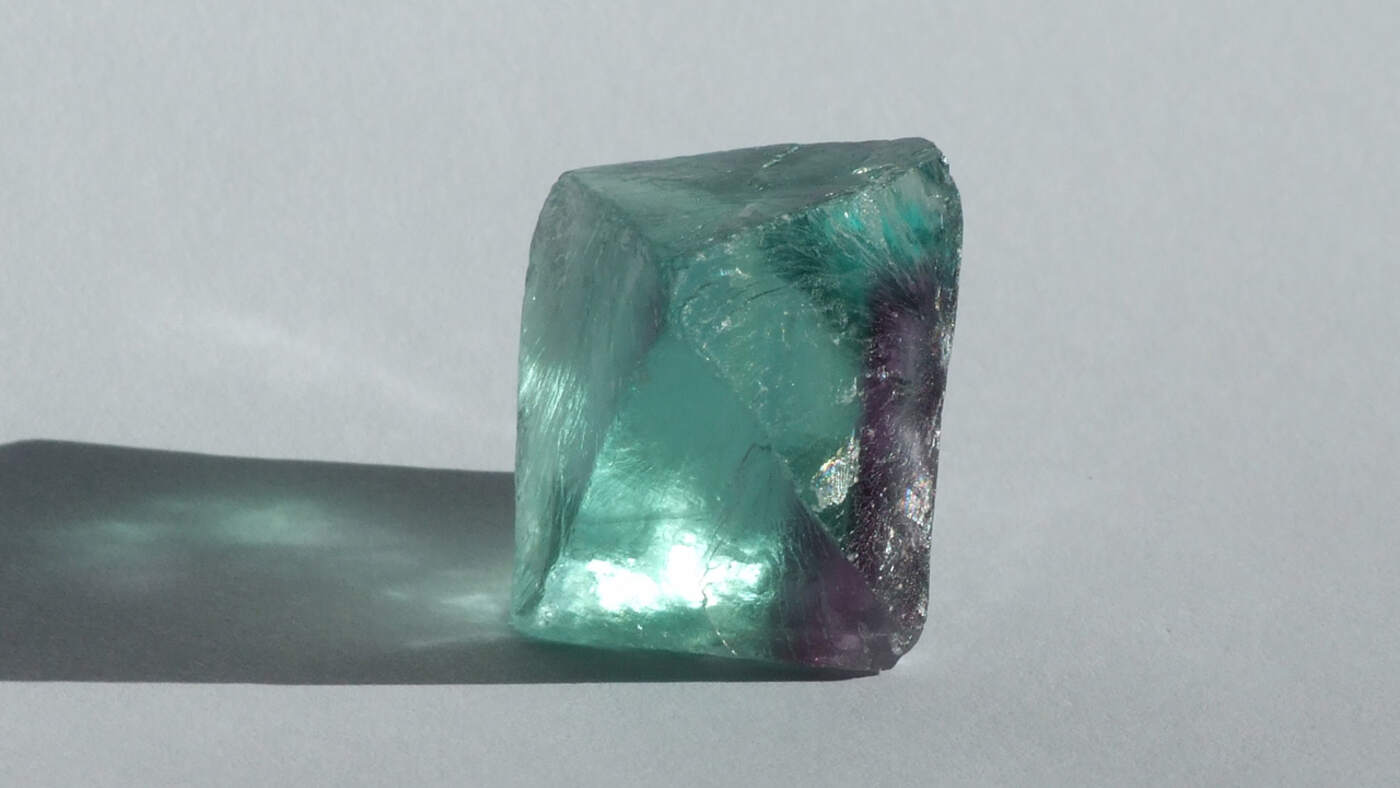
Fluorite comes in more colours than almost any mineral: purple, green, blue, yellow, pink, colourless, often in bands of several colours in one crystal. Blue John, a banded purple and yellow fluorite from Castleton in Derbyshire, England, has been carved into vases and jewellery since the eighteenth century and is nearly worked out; China supplies most fluorite today, with Mexico, Namibia and the United States. Fluorite has a hardness of 4 and cleaves perfectly in four directions, which makes it hard to cut and easy to chip. It is a stone for pendants, earrings and display, not for daily wear. Fluorite fluoresces under ultraviolet light, usually blue-violet; the word fluorescence was coined from it. Prices are low even for large, clean faceted stones, because the softness limits what jewellery can do with them.
Wearing them
Both need protective settings, gentle cleaning with warm water and a soft cloth, and no heat, acids or ultrasonic cleaners. Neither should live in a jewellery box beside harder stones. See which stones can be worn every day. Describe your piece and a goldsmith can set either in a bezel that takes the knocks for it.