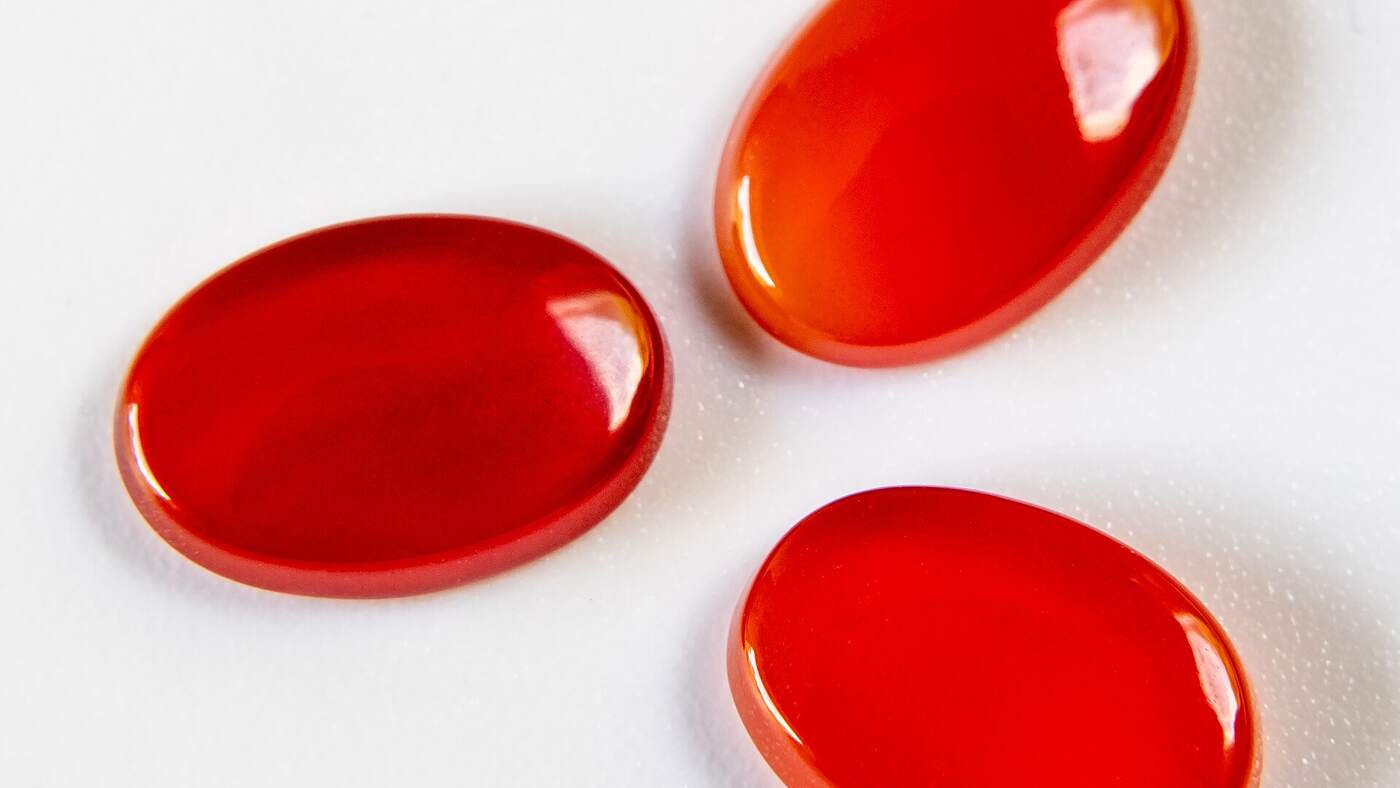
Chalcedony is quartz made of crystals too small to see, translucent and smooth, and it takes a polish and an engraving like no other stone. Onyx and agate are the banded members; these are the plain-coloured ones, the stones of Roman seals and signet rings.
Carnelian
Orange to red-brown, translucent, coloured by iron. Carnelian has been carved into seals and beads since the Bronze Age, and it engraves beautifully, which makes it a classic stone for a signet ring. Much carnelian is heated to deepen the colour, a treatment as old as the stone's use and fully accepted; the heated stones are the deep reddish ones, the natural ones more often a paler orange. Sard is the browner, darker variety, and sardonyx has white bands through it. India, Brazil and Uruguay supply most; the price is low, and an even, glowing orange without cloudy patches is the best of it.
Chrysoprase
The most valuable chalcedony: an apple green coloured by nickel, translucent and even. The finest comes from Marlborough in Queensland, Australia; Poland's Silesian deposits were the historic source, used in Prague's cathedral, and Tanzania and Brazil produce some. It is sometimes confused with jade and has been sold as "Australian jade", one of the misleading trade names. Chrysoprase can fade with prolonged heat or strong sun. Price follows the saturation and evenness of the green and the translucency; the best material costs what a good coloured stone does, ordinary material little.
Blue chalcedony
A soft, milky lavender-blue, popular with designers for its calm colour. Natural blue chalcedony is uncommon, from Namibia, Turkey and California; much on the market is dyed, which should be stated. Aquaprase, a blue-green chalcedony from Africa, is a recent trade name.
Bloodstone
Dark green chalcedony, jasper by another name, with red spots of iron oxide, also called heliotrope. It is the traditional birthstone for March in Britain, and a classic signet stone for men.
Wearing them
All chalcedony has a hardness of 6.5 to 7 and no cleavage, so it is tough and suits rings, cufflinks, signets and pieces worn daily. It is usually cut as a cabochon, bead, flat plate or intaglio. Clean with warm water and soap; avoid heat on chrysoprase and dyed stones, and the ultrasonic cleaner on dyed ones. See which stones can be worn every day. Describe your piece and a goldsmith can source a stone or have a seal cut.