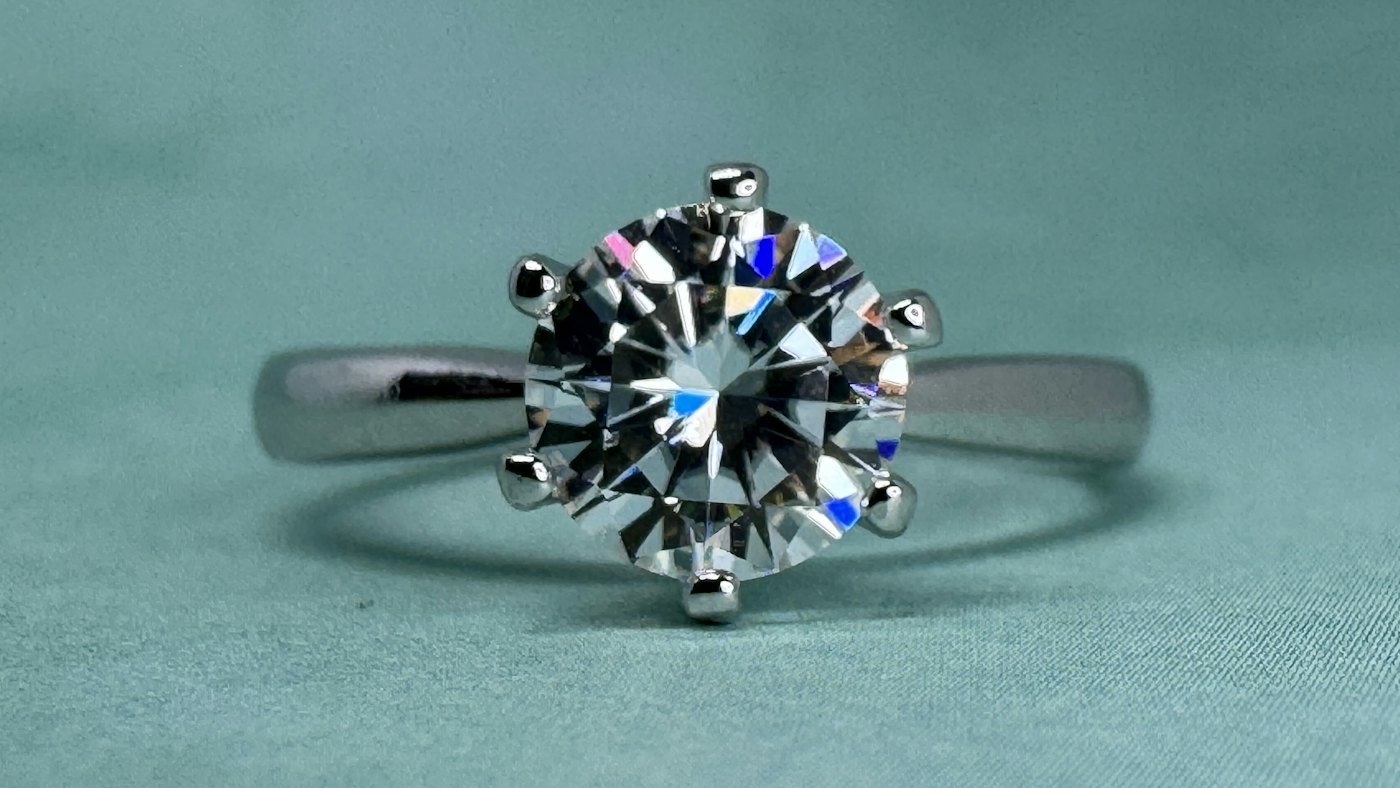
Moissanite is silicon carbide. It was discovered in 1893 by the chemist Henri Moissan in fragments of the meteorite that made the Canyon Diablo crater in Arizona, and natural moissanite is so rare that it plays no role in jewellery: every moissanite you can buy was grown in a laboratory, since the late 1990s, when the first gem-quality material came to market. It is not an imitation of anything; it is a stone with its own name, and the rules say it must be sold under it.
How it compares with diamond
Hardness. Moissanite has a hardness of 9.25 on the Mohs scale, harder than sapphire and second only to diamond among the stones used in jewellery. It is suited to a ring that is worn every day and keeps its polish for decades. See which stones can be worn every day.
Sparkle. Moissanite has more fire than diamond: its dispersion is more than twice as high, so it breaks light into more and stronger flashes of colour. Some people love that, others find it too much, especially in stones above a carat, where the rainbow flashes become a "disco ball" effect under strong light. It is also doubly refractive, so under a loupe the back facets look doubled; diamond's do not.
Colour. Modern moissanite is sold as colourless or near colourless, graded on the diamond scale as D to F or G to I. Older material, and some cheap material today, shows a faint yellow, green or grey tint in certain light.
Price. Moissanite costs a small fraction of what a mined diamond of the same size costs, and less than a lab-grown diamond, whose price has itself fallen far. A one-carat moissanite is priced in the hundreds of euros, not the thousands.
Not a diamond, and not cubic zirconia
Moissanite is a stone in its own right, not a diamond and not a "fake diamond", and a seller who calls it "moissanite diamond" is misleading you. Simple thermal diamond testers, which measure how a stone conducts heat, pass moissanite as diamond; jewellers use an electrical tester or a loupe to tell them apart, and a laboratory can always do it. It should not be confused with cubic zirconia either, which is far softer, heavier, and dulls over the years; moissanite does not.
What decides the price
Size, colour grade and cut, as with diamond, but on a much flatter curve: a three-carat moissanite costs only a few times a one-carat, where a three-carat diamond costs many times. The brand and the cut quality matter more than the material; a well-cut stone from a good grower looks better than a cheap one with the same weight.
Who chooses it
People who want a large, bright, durable stone without the cost of a diamond, or who prefer a stone that was not mined; couples who would rather put the budget into the gold and the making. It has no resale market to speak of, which matters to some and not to others. A goldsmith can set moissanite exactly like a diamond, in any setting. Mention it when you describe your piece.