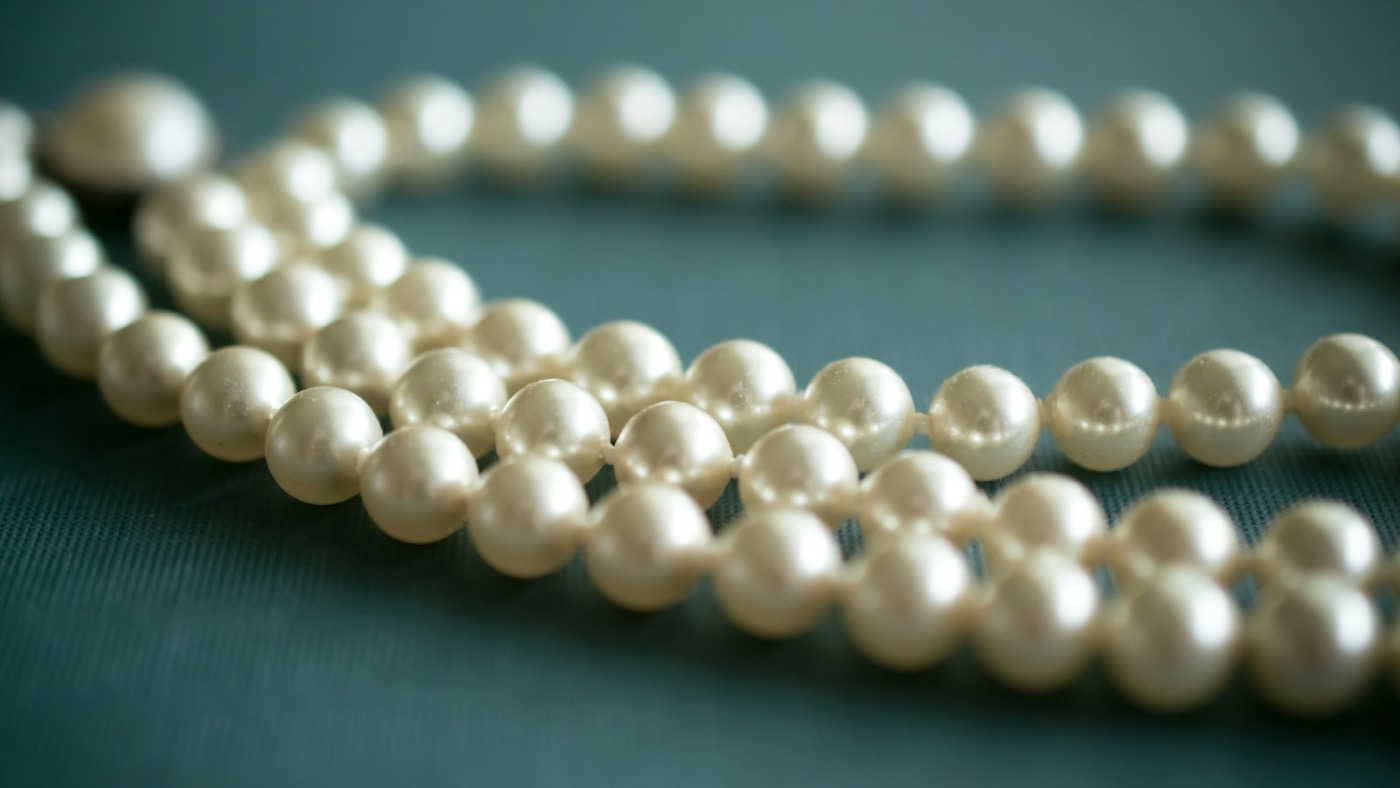
The pearl article explains how a pearl grows and what to look for. This one is the vocabulary: the types a jeweller will name, the shapes, the quality words and the lengths of a strand, so that a description reads as more than "a string of pearls".
The main types
Akoya. The classic round white pearl, grown in the Akoya oyster in Japan and China, usually 6 to 9 millimetres, with the sharpest, most mirror-like lustre of any cultured pearl. The standard for a uniform white strand and for stud earrings.
South Sea. From the large Pinctada maxima oyster in Australia, Indonesia and the Philippines: 9 to 16 millimetres and more, white, silver or gold, with a soft, satiny lustre. The largest and costliest cultured pearls; a matched strand takes years to assemble.
Tahitian. From the black-lipped oyster of French Polynesia: 8 to 14 millimetres, naturally dark, in grey, green, aubergine and the sought-after peacock, a green with pink and purple overtones. The only naturally dark pearls; black Akoya and freshwater pearls are dyed.
Freshwater. Grown in mussels, nearly all in China, in every shape and colour from white to pink, peach and lavender. Most are grown without a bead nucleus and are solid nacre, which makes them durable; sizes run from tiny seed pearls to 12 millimetres and beyond in the bead-nucleated kinds sold as Edison pearls. The best round freshwater pearls now rival Akoya at a fraction of the price. Biwa pearls are the freshwater pearls of Lake Biwa in Japan, the first commercial freshwater culture; the name is often misused for any freshwater pearl.
Keshi. Small pearls of solid nacre that grow by accident, without a nucleus, alongside a cultured pearl. Irregular, lustrous and popular with goldsmiths for that reason.
Mabe and blister. A mabe is a half-pearl grown against the inside of the shell, cut out and backed: large, domed and affordable, made for earrings and rings where only the front shows. A blister pearl is the natural version, left attached to a piece of shell.
Natural pearls. Pearls grown without human help, mostly fished in the Persian Gulf before the 1930s. Rare, X-rayed to prove they are natural, and sold at auction rather than in shops. A laboratory such as SSEF specialises in them; see coloured stone reports.
Shapes
Round is the rarest and dearest; near-round is what most strands are. Then drop (pear), button (flattened, for earrings and rings), oval, and baroque, the catch-all for irregular shapes, which South Sea and Tahitian baroques have made fashionable. Circled pearls carry rings around their body. Seed pearls are anything under about two millimetres, once stitched onto Victorian jewellery by the hundred.
The quality words
Lustre is how sharply the surface reflects light: a good pearl shows the reflection of a window with a clear edge, a poor one shows a blur. It is the first thing to judge. Orient is the play of soft rainbow colour just under the surface of a fine pearl, caused by light interfering in the layers of nacre; not every pearl has it. Surface is judged for spots, pits and wrinkles. Nacre thickness matters in bead-nucleated pearls: a thin coat wears through and shows the bead as a dull patch. Matching is what a strand is priced on: fifty pearls alike in size, colour, lustre and shape are worth far more than the same pearls loose.
Strand lengths
The names are old and the centimetres approximate.
| Name | Length | Where it falls |
|---|---|---|
| Collar | 30 to 33 cm | Snug against the neck, several rows |
| Choker | 35 to 40 cm | At the base of the neck |
| Princess | 42 to 48 cm | Just below the collarbone, the standard length |
| Matinee | 50 to 60 cm | On the chest |
| Opera | 70 to 90 cm | To the breastbone or below, worn single or doubled |
| Rope, sautoir | 100 cm and over | Knotted, doubled or wrapped |
A graduated strand runs from small pearls at the clasp to the largest at the centre; a uniform strand has pearls of one size and is the modern standard. Pearls are knotted between each one on silk, so a broken strand loses at most one pearl and the pearls do not rub. Read more about restringing.
Real or imitation
Imitation pearls are glass or shell beads coated with a lacquer, originally made from fish scales (essence d'orient), and the good ones look convincing. Rubbed gently against a front tooth, a real pearl feels faintly gritty, an imitation smooth; under a loupe a real pearl's surface shows a fine scaly texture, an imitation is even and often shows the coating flaking at the drill hole. "Cultured" is the correct word for a grown pearl and, in the pearl trade, the only place the word is allowed.
Care
Pearls are soft, about 3 on the Mohs scale, and their nacre dislikes acid. Put them on last, after perfume and hairspray, and take them off first. Wipe with a soft cloth, never with an ultrasonic cleaner, and have a strand that is worn often restrung every few years. See jewellery care.