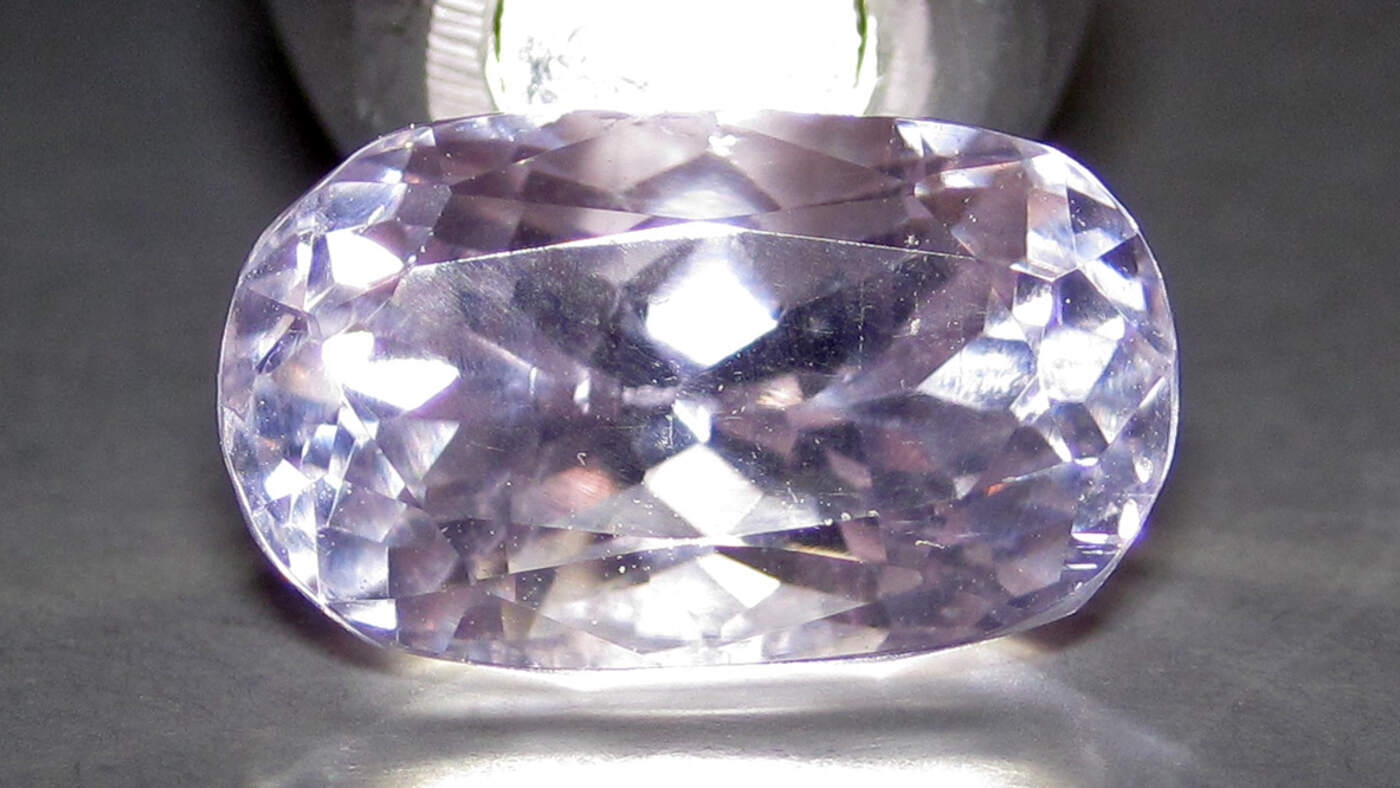
Kunzite is the pink to violet variety of the mineral spodumene, a lithium aluminium silicate, named after the gemmologist George Frederick Kunz of Tiffany & Co., who described it in 1902 from finds in California. Its green relative is hiddenite, its yellow one triphane.
What it looks like
Kunzite is pale to medium pink, lilac or violet, coloured by manganese, and strongly pleochroic: looked at from different directions the same crystal shows a deeper and a paler colour, and the cutter has to place the deepest colour face up, along the length of the crystal, which costs weight. Because the colour is delicate, kunzite is cut in generous sizes, often well over ten carats, and it stays affordable at that size; stones of fifty carats and more exist. Clean, saturated violet-pink is worth the most; pale stones cost little.
Where it comes from
Afghanistan (Nuristan and Kunar) and Pakistan supply the finest colour today; Brazil (Minas Gerais) the largest crystals; Madagascar, Myanmar and the United States (California, where it was first found) the rest. Origin does not change the price.
A stone for the evening
Kunzite fades in strong light. Prolonged sunlight, and even a shop window, will slowly drain its colour, which is why it has been called the evening stone. Heat does the same. Some kunzite is irradiated to deepen the colour and that colour fades faster; ask whether a stone is untreated. Wear it, but store it in the dark.
Wearing it
Kunzite has a hardness of 6.5 to 7, but it cleaves easily in two directions, which makes it difficult to cut and vulnerable to knocks; a sharp blow on the edge can split it. It is better suited to earrings and pendants than to a ring worn daily; in a ring it needs a protective bezel and care. See which stones can be worn every day.
Care
Warm water and mild soap only. No ultrasonic cleaner, no steam, no sudden changes in temperature, and out of the sun when not worn. Describe your piece and a goldsmith can set a kunzite with its cleavage protected.