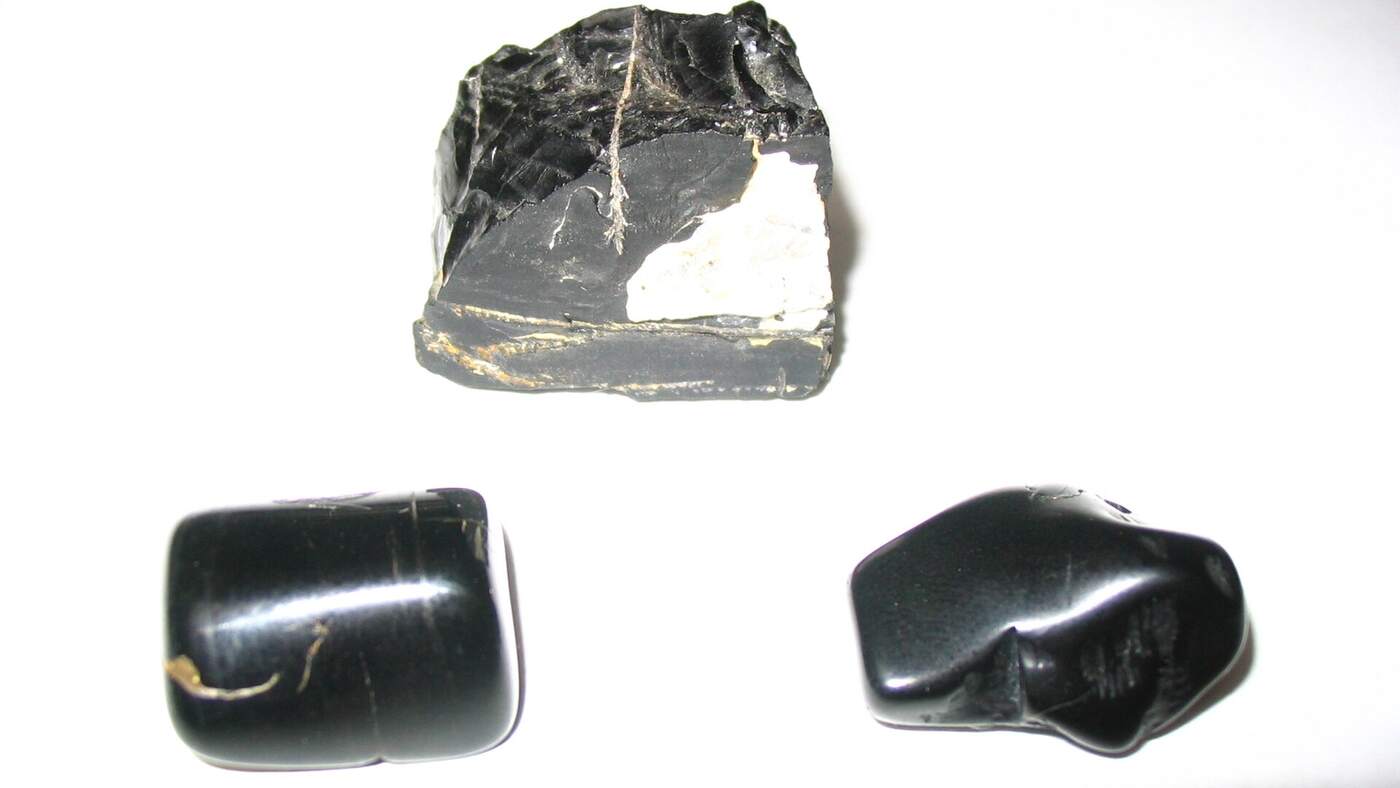
Jet is not a mineral but fossilised wood, a form of lignite: driftwood of trees related to the monkey puzzle, buried in sea mud in the Jurassic and pressed for a hundred and eighty million years. It is black, opaque, very light, and warm to the touch, and it takes a deep, soft polish that no black stone quite matches. "Jet black" is named after it, and its Greek name, gagates, after the town of Gagae in Lycia where the ancients got it.
Whitby and mourning jewellery
The most famous jet comes from Whitby on the coast of Yorkshire in England, where it washes out of the cliffs. The Romans worked it in York; the great period came in the nineteenth century, when Whitby had some fifteen hundred people carving it into beads, brooches, chains, cameos and bracelets. After the death of Prince Albert in 1861 Queen Victoria wore black for the rest of her life and allowed only jet at court, and it became the stone of mourning jewellery across Europe; the trade collapsed when fashion moved on in the 1880s. Whitby still has a few carvers, and antique Whitby jet is collected.
Spanish jet, azabache, from Asturias, was carved for centuries before that into amulets and the clenched-fist figa for pilgrims to Santiago de Compostela, and is still sold there. France, Germany, Turkey and the United States have jet too.
Real jet and the imitations
Because jet was fashionable and slow to carve, it was imitated at once.
- "French jet" is black glass: cold, heavy, and it rings when tapped.
- Vulcanite, a hardened rubber, was moulded rather than carved, smells of sulphur when rubbed and fades to brown with age.
- Bog oak is brown-black and shows wood grain.
- Cannel coal and anthracite are duller and crumble.
- Bakelite and plastics came later, moulded with seams.
Real jet is very light, slightly warm, takes static electricity when rubbed on wool, and, rubbed on unglazed porcelain, leaves a brown streak where glass leaves none. Under a loupe, carved jet shows tool marks, moulded imitations show seams. See synthetic and imitation stones.
What decides the price
Antique Whitby pieces are priced as antiques: the quality of the carving, the condition and the provenance. New jet is modest in price; large, sound pieces for carving are scarcer than small ones, and a fine carved brooch or a faceted bead necklace is priced on the hours in it. There is no grading.
Wearing it
Jet has a hardness of only 2.5 to 4 and scratches easily, but it is tough rather than brittle: it survives being dropped where glass would not. It suits beads, pendants, earrings and brooches, and a signet or a cocktail ring for occasional wear. Keep it away from heat, solvents and strong sunlight, which can dry and crack it, and clean it with a soft cloth; never soak it or put it in an ultrasonic cleaner. Store it apart from harder stones. See which stones can be worn every day. Describe your piece and a goldsmith can set a carved piece or restring an old necklace.