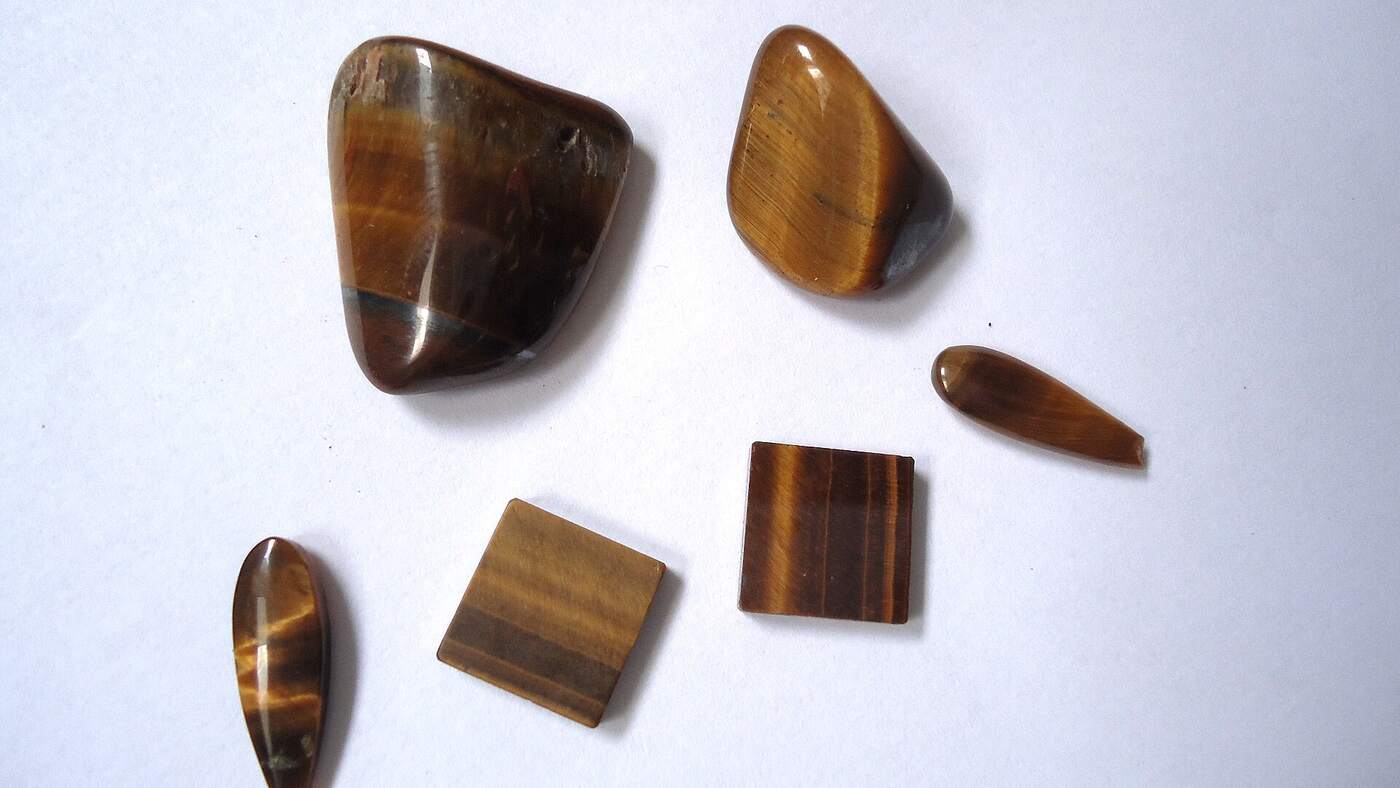
These three are all quartz, and all owe their look to what is mixed into them rather than to clarity or colour alone. They are among the toughest stones a goldsmith can set, they cost little, and no two pieces are alike, which is why designers reach for them when a piece needs pattern rather than sparkle.
Jasper
Jasper is opaque chalcedony, quartz made of grains too small to see, coloured by iron oxides and clay in red, yellow, brown and green, often in patterns that look like landscapes, ripples or brushstrokes. The names describe the pattern and the place: picture jasper (desert scenery from Oregon and Idaho), ocean jasper (green and pink orbs from one coastal deposit in Madagascar), Mookaite (cream, red and mustard from Western Australia), polychrome jasper, dalmatian jasper, and red jasper, the plainest and the commonest. Bloodstone, green with red spots, is jasper too. It is cut as cabochons, beads and flat plates, and it was carved into seals in antiquity.
Price follows the pattern and the source: plain red jasper is cheap, a striking ocean jasper or picture jasper cabochon costs what the cutter's choice of the pattern is worth. Jasper is not treated; dyed "jasper" in bright colours is usually dyed howlite or magnesite.
Tiger's eye
Tiger's eye is quartz that has replaced fibres of crocidolite, a form of asbestos, keeping the fibrous structure while locking the fibres in silica. Cut as a cabochon, it shows a silky band of light that moves across the stone as it turns, a broad cat's eye. The usual colour is golden brown; blue-grey is hawk's eye, the unoxidised form; reddish tiger's eye is heated. Tiger iron is tiger's eye banded with red jasper and hematite. South Africa's Northern Cape supplies nearly all of it, with some from Western Australia. It is cheap in beads and cabochons, and a well-oriented stone with a sharp band costs a little more. Because the asbestos fibres are bound in quartz, finished tiger's eye is safe to wear; the dust from cutting it is not, which is the cutter's concern. See optical effects.
Aventurine
Aventurine is quartz with a sprinkling of tiny flakes of another mineral that glitter in the light: green fuchsite mica in the common Indian material, hematite or goethite in the orange and brown kinds, and rarely blue. The glitter is called aventurescence, after the Venetian glass with copper flakes that imitates it and was made first. Green aventurine is sold as "Indian jade", one of the misleading trade names; it is not jade, and it is much cheaper. Price is low; an even green with fine, bright glitter is the best of it.
Wearing them
All three have a hardness of 6.5 to 7 and no cleavage, so they are tough and suit rings, cufflinks, signets and beads worn daily. Warm water and soap are all they need; the ultrasonic cleaner is fine for jasper and aventurine, less so for tiger's eye with cracks. See which stones can be worn every day. Describe your piece and a goldsmith can find a cabochon with the pattern you like.