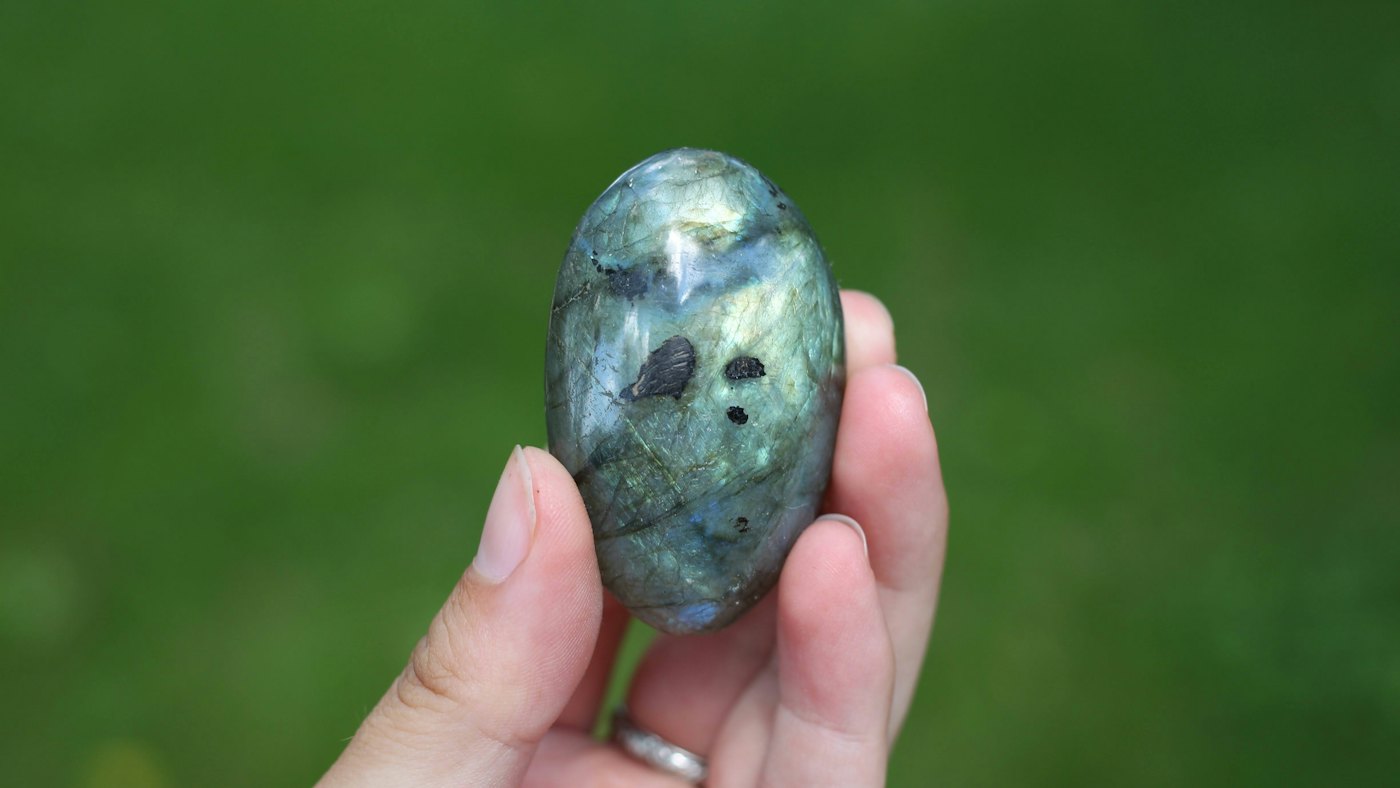
Labradorite looks like an unremarkable grey stone until the light hits it at the right angle. Then it flashes blue, green, gold, sometimes orange and violet, and goes grey again as you turn it. The effect is called labradorescence and comes from light interfering between thin layers inside the feldspar; see optical effects.
What to look for
A good labradorite flashes strongly, over a large part of the surface, and from more than one angle, on a body that is not too dark. Blue is the commonest flash colour and the cheapest; gold, green and violet cost more, and a stone that shows the full spectrum in broad sheets is the top of the market. Those stones are called spectrolite, a name given to the material found in Finland in the 1940s and now used for any full-spectrum stone. Every stone is different, and the flash only shows from certain directions, so look at a stone, or a video of it, while it moves; a photograph shows one angle only.
How it is cut
Usually as a smooth cabochon or a flat slab, oriented so the flash faces up, because a smooth surface shows it best. Rose cuts and faceted tops are popular too and break the flash into many small planes. Beads show it in patches.
Labradorite or moonstone
Both are feldspars with a sheen, and the trade confuses them on purpose. Moonstone is pale and translucent with a soft, mostly blue or white glow; labradorite is grey to black with a hard, metallic flash in several colours. "Rainbow moonstone" is in fact a pale labradorite. Neither is normally treated.
Wearing it
Labradorite has a hardness of 6 to 6.5 and, like all feldspars, two cleavage directions along which a hard knock can split it. It works well in pendants, earrings and brooches. In a ring, choose a bezel setting and take it off for rough work. Warm water and a soft cloth; no ultrasonic cleaner, no steam. See which stones can be worn every day.
Value and where it comes from
Labradorite is affordable, even in large stones, which makes it suited to bold, sculptural pieces; a full-spectrum spectrolite cabochon costs more, but nothing like a precious stone. It is named after Labrador in Canada, where it was described in 1770. Madagascar supplies most of what is on the market today, Finland the spectrolite, and Canada, Russia and the United States the rest. See labradorite jewellery or describe your piece.