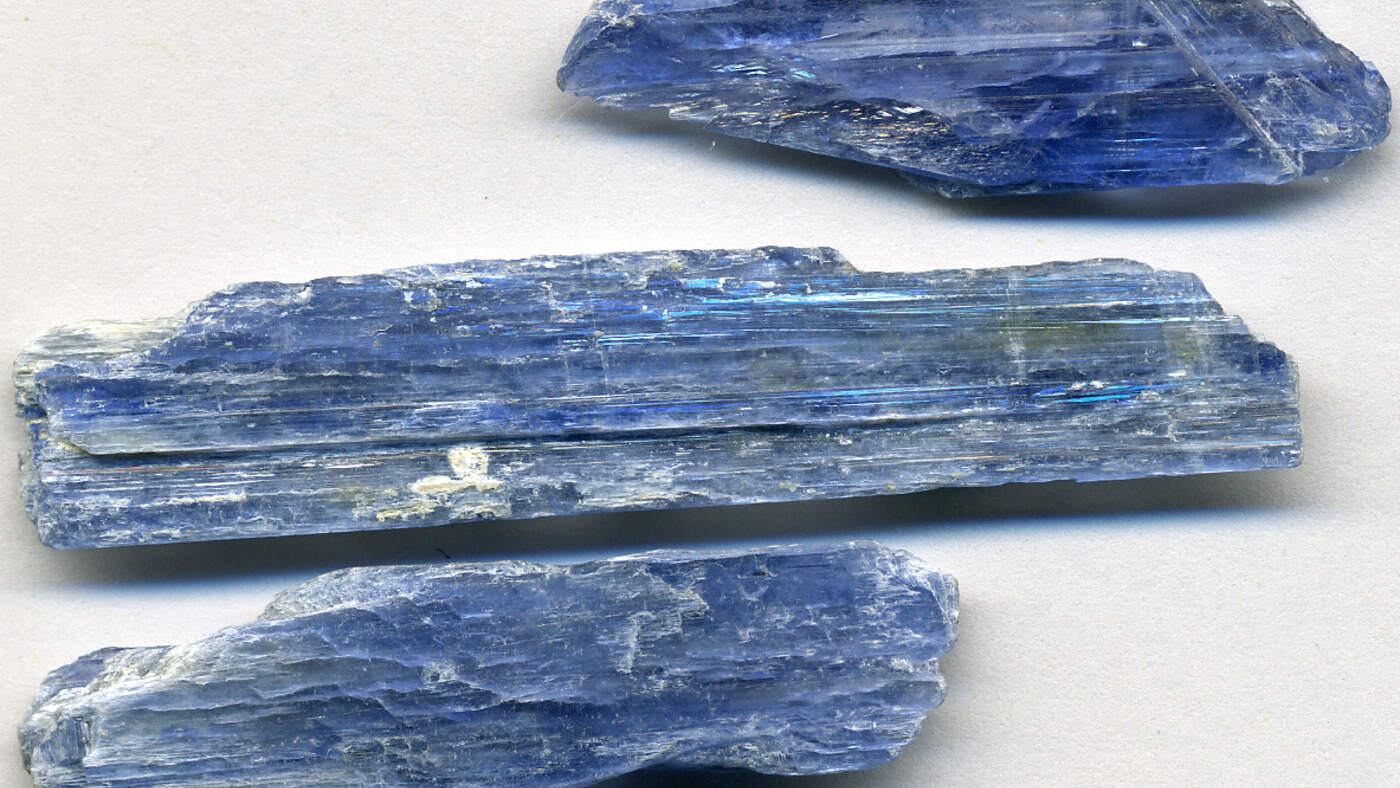
Kyanite is best known in a blue that can rival sapphire, often with a slightly streaky, bladed look that betrays its crystal structure. It also comes in green, teal, orange and colourless. The name comes from the Greek for blue, and the old name disthene, "two strengths", from the property that makes it unusual.
Two hardnesses
Kyanite is the textbook example of a mineral whose hardness depends on direction: about 4 to 4.5 along the length of the blade-shaped crystal and 6 to 7 across it. A steel knife scratches it one way and not the other. That makes it difficult to cut, because the same stone is soft in one direction and hard in the next, and it has a perfect cleavage as well; the cutter has to orient every stone with care, and it explains why clean, well-cut kyanite is uncommon and why most of the production goes into industry, where kyanite is a raw material for heat-resistant ceramics.
Colours and sources
Fine blue kyanite, saturated and even enough to facet, has come from Nepal since the 1990s and set the standard; the best of it is a cornflower to royal blue that passes for sapphire at a glance. Brazil (Minas Gerais), Kenya, the United States (North Carolina), Myanmar and Switzerland produce blue and colourless material, mostly streaky. Green and teal kyanite comes from Brazil and East Africa. Orange kyanite, coloured by manganese, was found in Tanzania in 2008 and is rare enough to be a collector's stone. Kyanite is not treated and there is no synthetic; what you see is what came out of the ground.
What to look for
An even, saturated blue without colour zoning, and a clean stone; most kyanite shows some streaks, colour banding or silvery cleavage flashes, and a stone free of them is worth several times one with them. Faceted stones above three or four carats without visible flaws are scarce. Prices are modest: fine Nepalese blue costs a small fraction of sapphire of the same colour, and streaky cabochon material is cheap.
Kyanite or sapphire
Both are blue, and kyanite has been passed off as the dearer stone. Kyanite is lighter for its size, softer, and shows its bladed structure and cleavage under a loupe; a refractometer separates them at once, and sapphire has no cleavage at all. See how a gemmologist identifies a stone. For a stone sold as sapphire at a sapphire price, ask for a report.
Wearing it
Because of its soft direction and its cleavage, kyanite is a stone for earrings and pendants, or for a ring in a protective bezel setting worn with care; a knock on the wrong edge can split it. Warm water and a soft cloth; no ultrasonic cleaner, no steam. See which stones can be worn every day. Describe your piece and a goldsmith can set a kyanite so that its weak direction is protected.