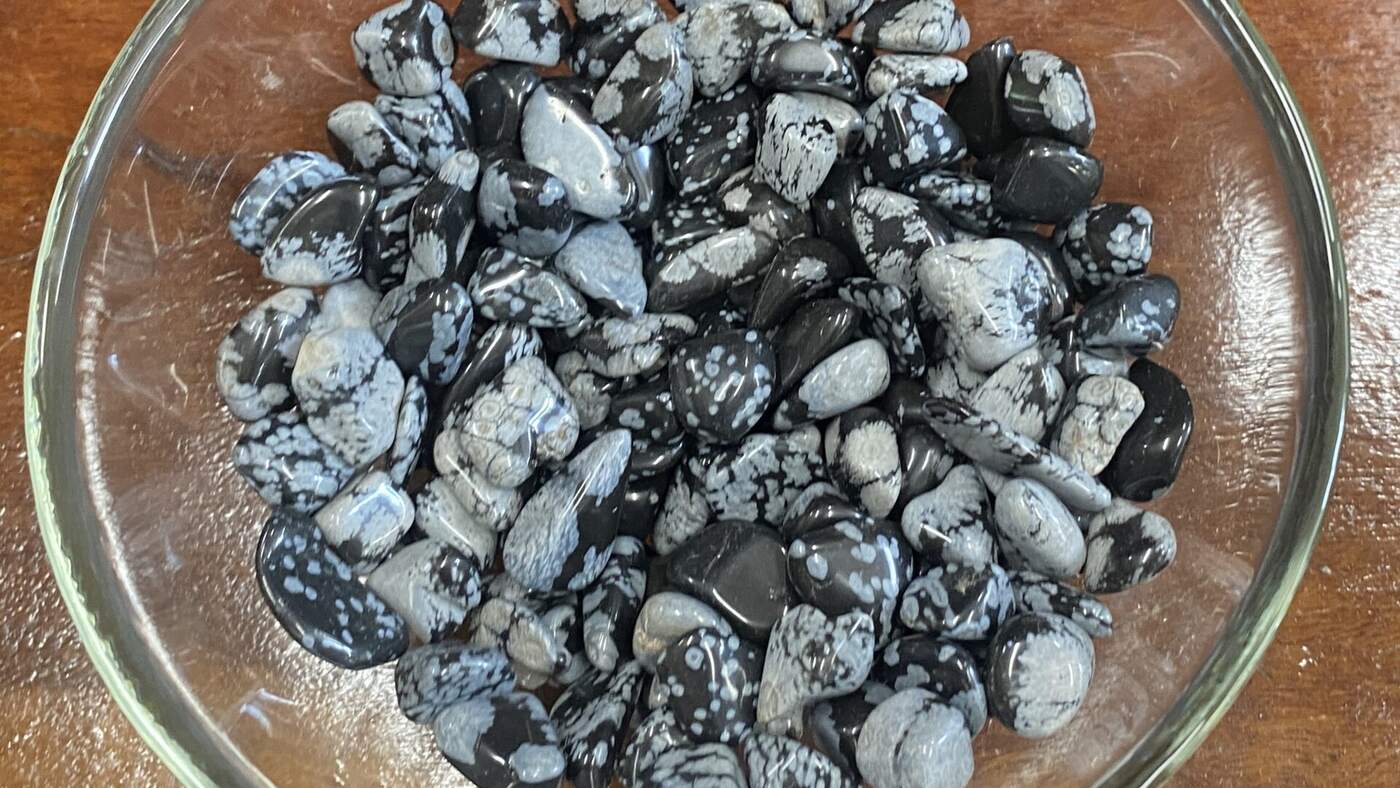
Obsidian is natural glass, formed when silica-rich lava cools too quickly for crystals to grow. It is usually black, and the black comes from finely scattered iron and magnesium minerals in a glass that would otherwise be clear. Because glass slowly crystallises over geological time, no obsidian is very old; the pieces in jewellery came from volcanoes that erupted within the last few million years.
The varieties
Plain black obsidian is the commonest and the cheapest. The named varieties are what jewellers look for.
- Snowflake obsidian carries white to grey rosettes of cristobalite, a form of silica that crystallised in the glass, and is cut so the flakes sit evenly on the dome.
- Mahogany obsidian is streaked brown and black by iron oxide.
- Sheen obsidian owes its gold or silver shimmer to layers of minute gas bubbles; rainbow obsidian its bands of green, purple and gold to layers of tiny crystals. Both effects only show when the cutter orients the cabochon to the layers, which is why a good rainbow cabochon costs many times a plain one.
- Apache tears are small rounded nodules of translucent obsidian weathered out of perlite in the American south-west.
- Fire obsidian, from a single area in Oregon, shows patches of spectral colour from ultra-thin layers of crystals and is a collector's stone.
Where it comes from
Anywhere with recent volcanoes: Mexico, the western United States (Oregon, Arizona, Utah), Armenia, Turkey, Iceland, the Lipari islands off Sicily, Ethiopia and Kenya. The source rarely affects the price; the variety and the cut do.
How it is used
Obsidian is soft enough to carve and cut easily, so it appears as cabochons, beads, spheres, carved pendants and intaglios, and it takes a mirror polish. The Aztecs made mirrors and blades from it; a fresh obsidian edge is sharper than steel, which is why it is still used for some surgical scalpels. In jewellery its deep black suits silver, contrasts with pale stones and is a staple of men's pieces.
What decides the price
Very little, for plain black; obsidian is one of the most affordable materials a goldsmith can set. Value rises with a sheen or rainbow that is bright and well oriented, an even snowflake pattern, and the size and quality of a carving. There is no grading and no laboratory report; the cutter's work is most of what you pay for.
Obsidian or glass
Manufactured black glass is sold as obsidian and, being glass too, is hard to tell apart without a laboratory. Under a loupe, natural obsidian usually shows minute dust-like crystallites and a faint flow texture; factory glass shows round gas bubbles and swirls, and it is often too perfectly uniform. Both feel the same in the hand. Because the price is low, the risk is small, but a piece sold as fire or rainbow obsidian at a high price deserves a closer look. See synthetic and imitation stones.
Wearing it
With a hardness of 5 to 5.5, a glassy fracture and no crystal structure to stop a crack, obsidian scratches and chips readily. It suits pendants, earrings, beads and brooches; in a ring it will not stay pristine, and a bezel is the least you should ask for. Keep it out of the ultrasonic cleaner and away from other jewellery in the box; a soft cloth and warm water are enough. See which stones can be worn every day. Describe your piece and a goldsmith can source a cabochon or a carving.