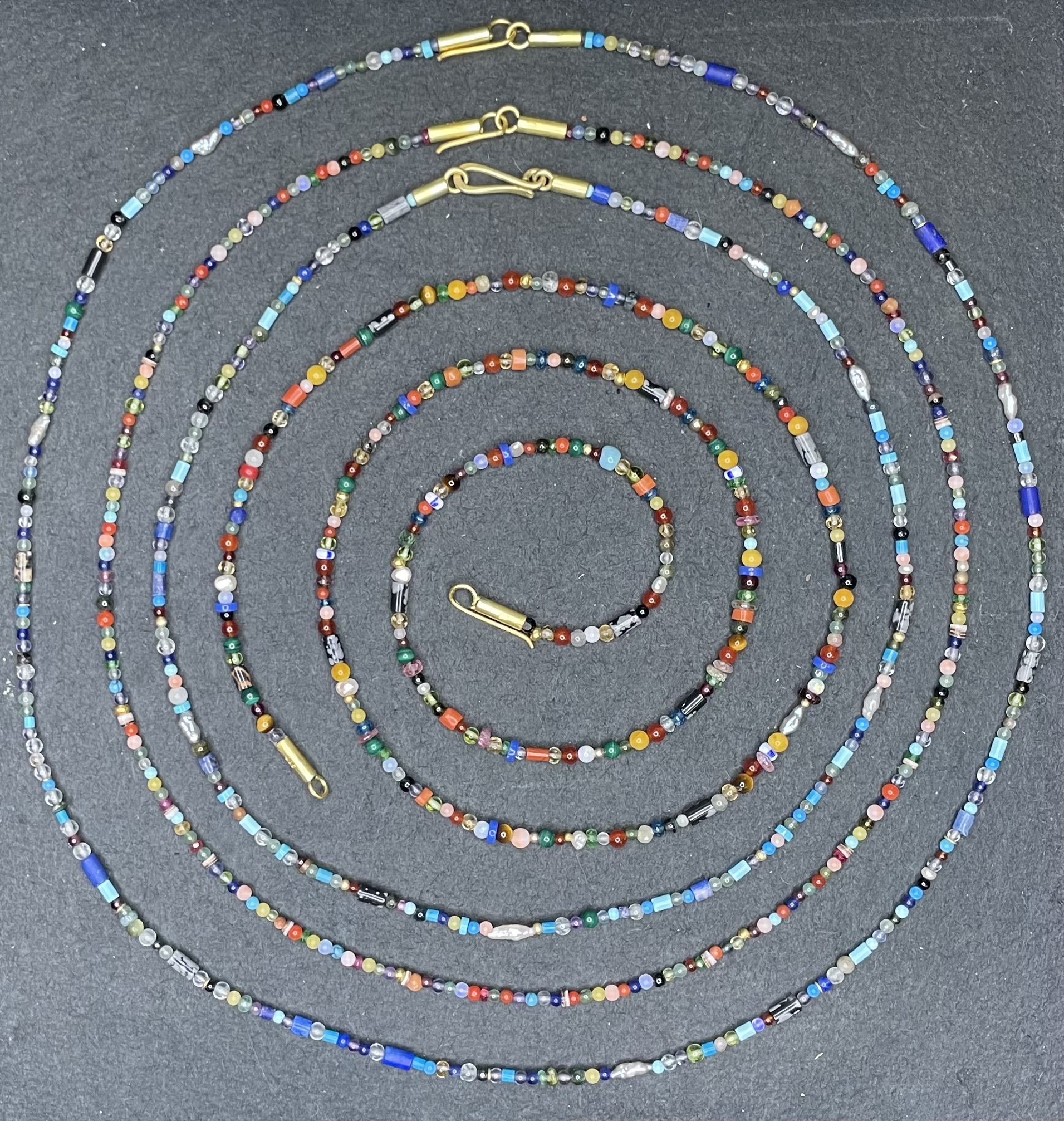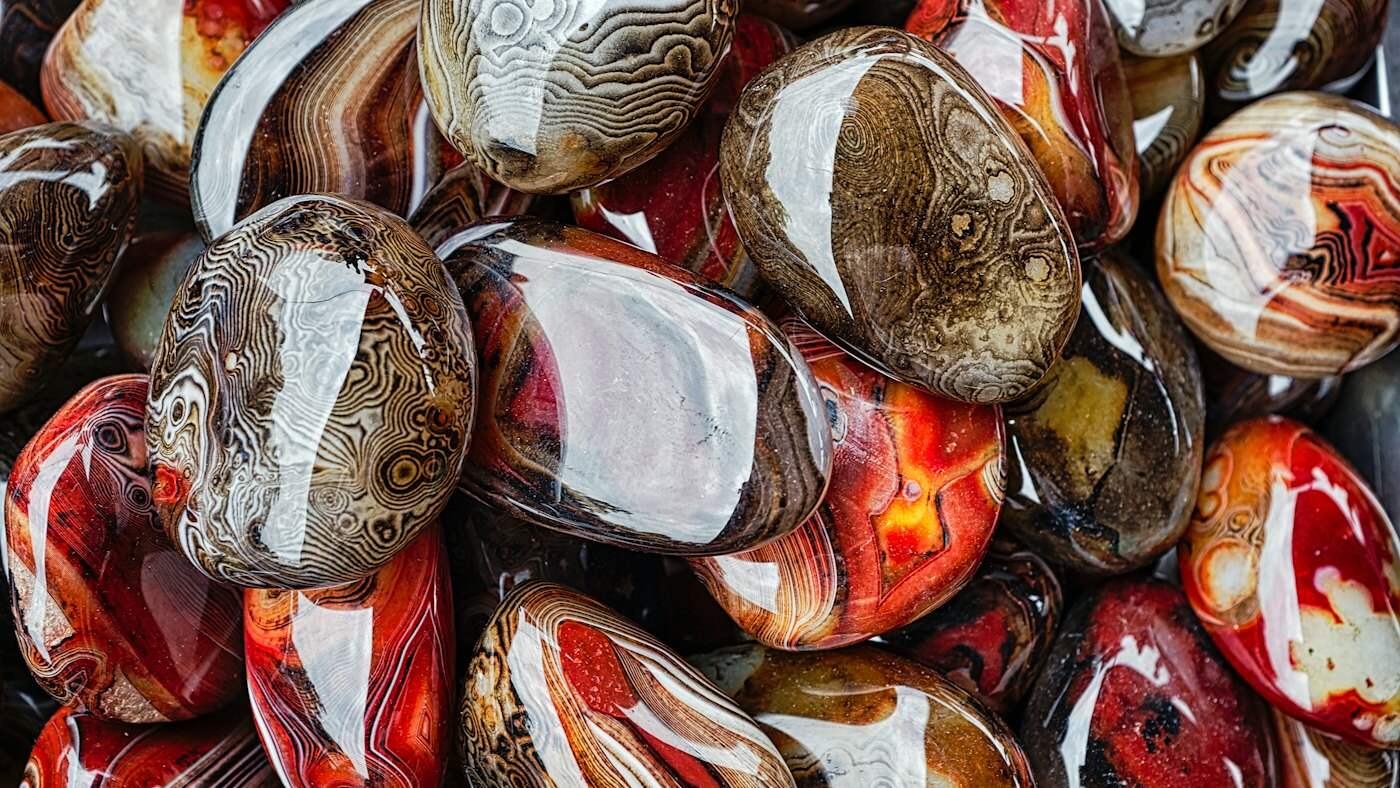
Onyx and agate are both chalcedony: quartz made up of crystals too small to see, opaque to translucent, and it takes a polish and an engraving like no other stone. The Sumerians cut seals from it, the Romans cameos, and Idar-Oberstein in Germany built an industry on it that still runs; see carnelian, chrysoprase and chalcedony for the plain-coloured members of the family.
Agate
Agate is chalcedony with bands or patterns, and it comes in an enormous variety: concentric rings, straight bands, landscapes, moss-like inclusions (moss agate, which strictly has no bands and is a separate thing), lace and fortress patterns, eye agates, fire agate with its iridescent film. Thin slices show the banding best, and the names describe the pattern and the place: Botswana agate with its fine pink and grey bands, crazy lace from Mexico, dendritic agate with fern-like black traces. Natural colours are mostly greys, browns, whites and soft reds; bright blue, pink, green or purple agate slices and beads are dyed, a practice as old as Idar-Oberstein and accepted when it is stated. Value is in the pattern and the cutting: a well-chosen slice of fine banding or a dendritic agate with a landscape in it costs many times a plain bead, but the material itself is cheap.
Onyx
In the strict sense, onyx is chalcedony with straight, parallel black and white bands, and sardonyx has brown-red and white ones. These layers are what cameo carvers use: the figure is cut in the pale layer, the background is the dark one, which is why a fine cameo is a piece of onyx or sardonyx, not a shell.
In jewellery, "onyx" nearly always means plain black onyx. Natural even black is rare. Almost all black onyx is grey chalcedony that has been dyed black by soaking in sugar solution and then acid, a process the Romans knew. The colour goes right through, is stable and does not fade, and the practice is accepted throughout the trade; a seller who calls it "natural black onyx" is the one to doubt. Black onyx with diamonds and white metal is the look of Art Deco, and it is the classic plate for a men's signet ring.
Wearing them
Chalcedony has a hardness of 6.5 to 7 and no cleavage, so it is tough and suits signet rings, cufflinks, beads and pieces worn every day. It scratches in the long run against harder stones and the polish dulls, and a goldsmith can repolish a flat plate. Warm water and soap; the ultrasonic cleaner is fine for undyed stones and best avoided for dyed ones. See which stones can be worn every day.
Imitations
Black glass and black plastic imitate onyx in cheap jewellery; glass shows bubbles, plastic is warm and light. Dyed agate sold as something rarer, "black jade" or "black tourmaline", is the commoner deception. See synthetic and imitation stones.
Value and where it comes from
Both are affordable; the price is in the cutting, the carving and the pattern, not in the raw material. Brazil and Uruguay supply most agate, Botswana, Mexico, India and Madagascar the named kinds; the black onyx in jewellery is mostly Brazilian chalcedony dyed in Germany or India. See onyx jewellery and agate jewellery, or describe your piece.