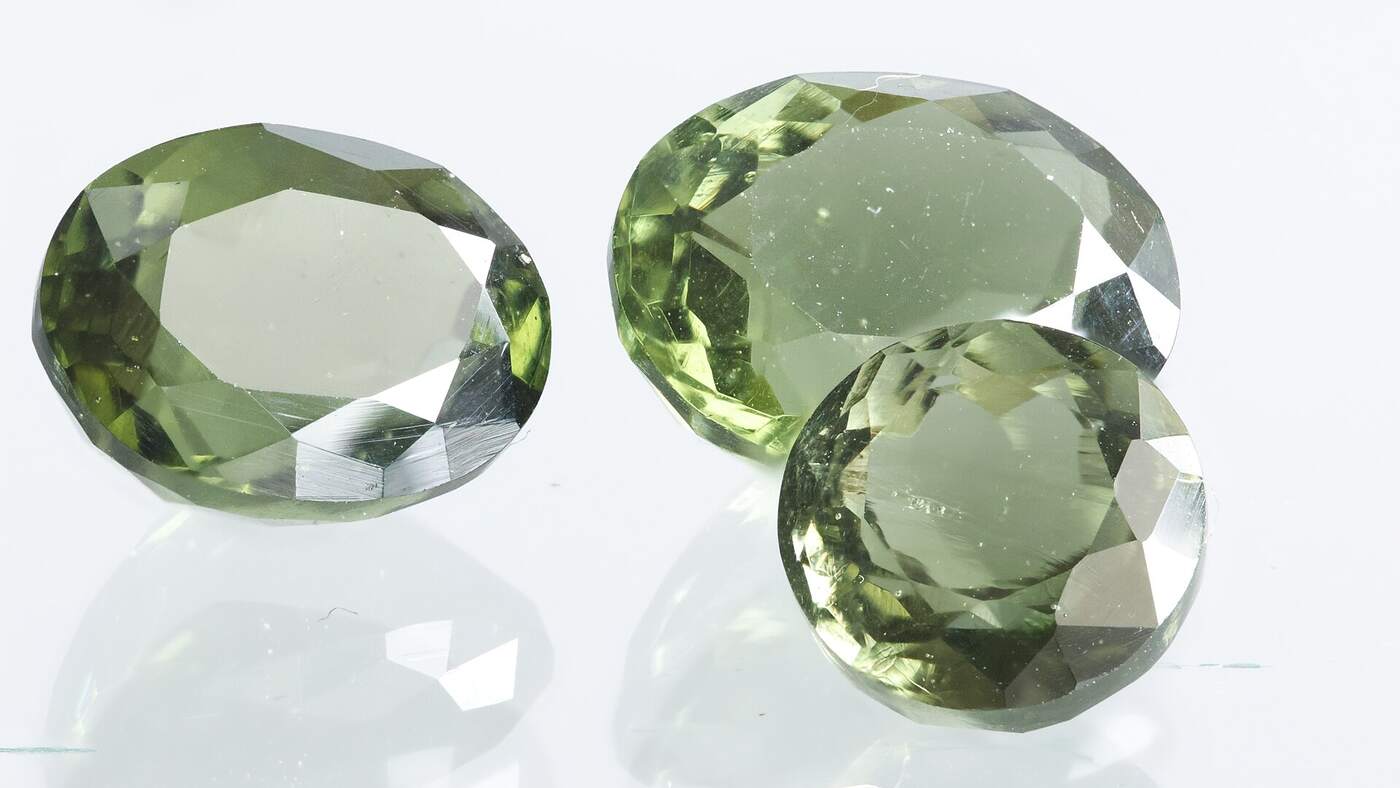
Moldavite is a natural glass, olive to bottle green, with a wrinkled, sculpted surface. It formed when a large meteorite struck what is now southern Germany, the Ries crater near Nördlingen, about fifteen million years ago: molten rock was flung hundreds of kilometres and cooled in flight, falling in what is now the Czech Republic along the Vltava, the Moldau in German, which gives the stone its name. It is the best known of the tektites, and the only one in a colour that jewellery wants.
What it looks like
Most moldavite is a translucent bottle green with a pitted, grooved surface shaped by aeons of soil acids. Pieces from Besednice, with deep "hedgehog" sculpting, are prized by collectors; pieces from other fields are smoother. Inside, the glass carries wavy streaks and small round or elongated bubbles, and under a loupe those inclusions are the signature of the real thing. Colour ranges from pale olive to deep green; a lively green with an intact sculpted surface is worth the most.
How it is used
Many people wear moldavite rough, as it was found, set in a bezel or wrapped in wire, because the pitted surface is part of its appeal. Clean pieces are also faceted, giving a transparent green stone with the fine streaks and bubbles still visible inside; large clean faceted stones are uncommon.
What decides the price
Moldavite is sold by the gram, and the price has risen steeply since its popularity took off around 2020, with the Czech fields largely mined out and collecting restricted. A small rough piece is affordable; a large, well-sculpted specimen or a clean faceted stone is not. Buy by weight from a dealer who names the field it came from.
Imitations
Moldavite's popularity has brought a flood of green glass imitations, some moulded with a convincing rough surface and sold in quantity online. Real moldavite has fine, wavy internal streaks and tiny bubbles, a matt rather than glossy skin, and never the perfect uniformity of glass; a piece that looks too shiny, too even, too large or too cheap is suspect, and "moldavite" from anywhere but the Czech Republic does not exist. See synthetic and imitation stones.
Wearing it
As a glass with a hardness of 5.5, moldavite scratches and chips. It suits pendants and earrings; in a ring it needs a protective bezel and will not stay pristine. See which stones can be worn every day. Clean with warm water and a soft brush; no ultrasonic cleaner. It is not radioactive and not a meteorite itself, only the melted earth a meteorite threw into the air. Describe your piece and a goldsmith can set a rough piece so the sculpting shows.