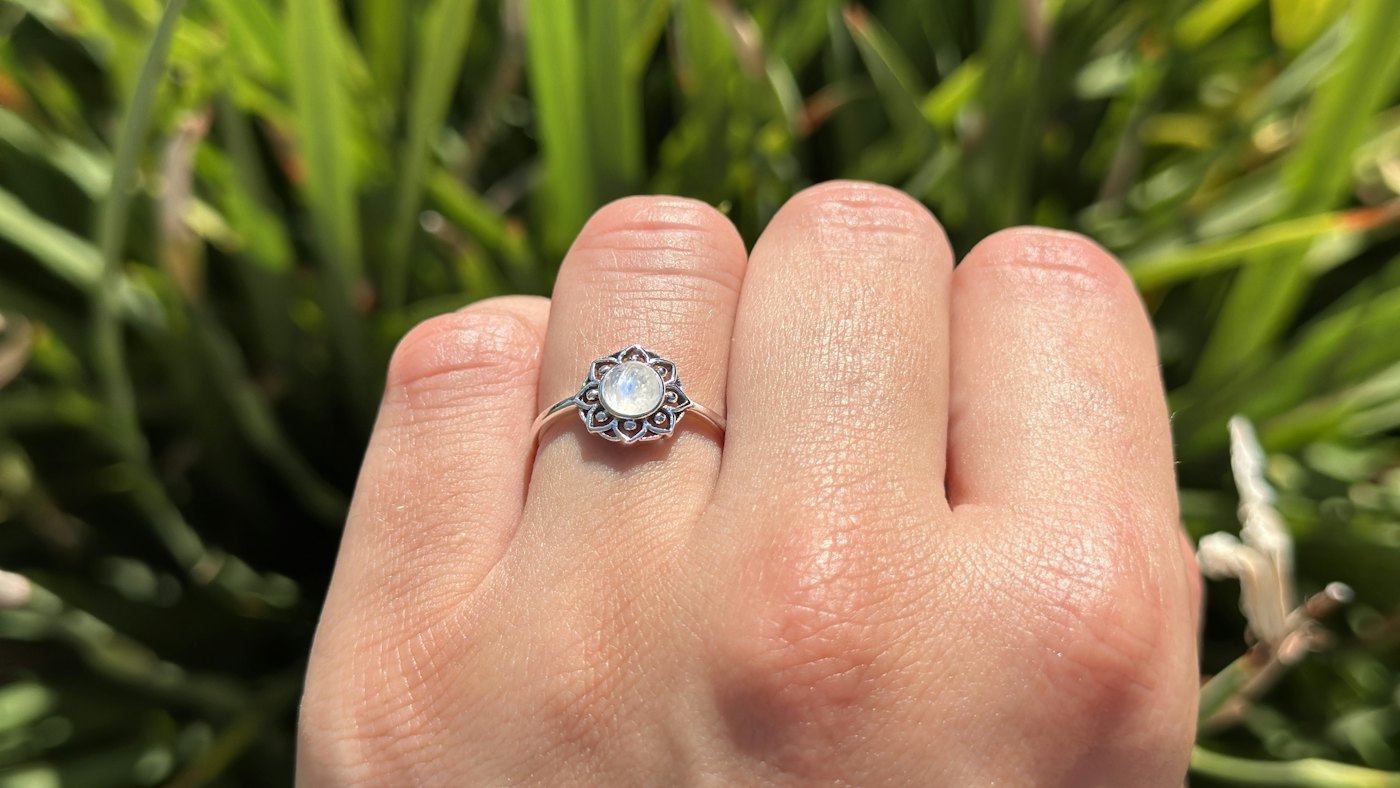
Moonstone is a feldspar. Its charm is the soft light that glides across the stone as you move it, called adularescence after adularia, the feldspar it occurs in, and caused by light scattering between very thin layers inside the stone. The Romans thought it was moonlight made solid; Art Nouveau jewellers, Lalique first among them, made it the stone of their era, and it has never been out of fashion since. See optical effects.
What makes a good one
The finest moonstone is almost transparent and colourless, with a strong blue sheen that sits in the centre of the dome and moves as you tilt it; that grade comes from Sri Lanka and from a few Indian and Burmese deposits and is scarce. Stones with a white sheen, or a milky, cloudy body, are commoner and cost far less. Moonstone also comes in peach, grey, green and brown, and a cat's eye is occasionally cut from fibrous material. Transparency, the colour and strength of the sheen, and how well it is centred decide the price.
Rainbow moonstone
What the trade calls "rainbow moonstone" shows several colours in its sheen. Strictly speaking it is a pale variety of labradorite, a close relative, and comes mostly from India. It is pretty and cheap, and it should be sold under that name.
Why it is a cabochon
The sheen only shows well over a smooth dome, so moonstone is almost always cut as a cabochon. The cutter has to orient the stone exactly, so that the light sits in the middle of the dome and not off to one side; that orientation, more than the rough, is the cutter's skill and part of what you pay for. Carved moon faces are a tradition of Idar-Oberstein.
Wearing it
Moonstone has a hardness of 6 to 6.5, and it can split along internal planes when it takes a hard knock. It is ideal for earrings and pendants. In a ring it asks for a protective setting, such as a bezel, and an owner who takes it off for rough work. See which stones can be worn every day.
Care
Lukewarm water, mild soap and a soft cloth. No ultrasonic cleaner, no steam. Store it apart from harder stones, which will scratch it. Moonstone is not treated, and glass imitations with a milky sheen exist but show none of the layered light of the real stone.
Where it comes from
Sri Lanka and India are the classic sources; Madagascar, Tanzania and Myanmar also produce it. Moonstone is a birthstone for June, beside pearl and alexandrite. See moonstone jewellery or describe your piece.