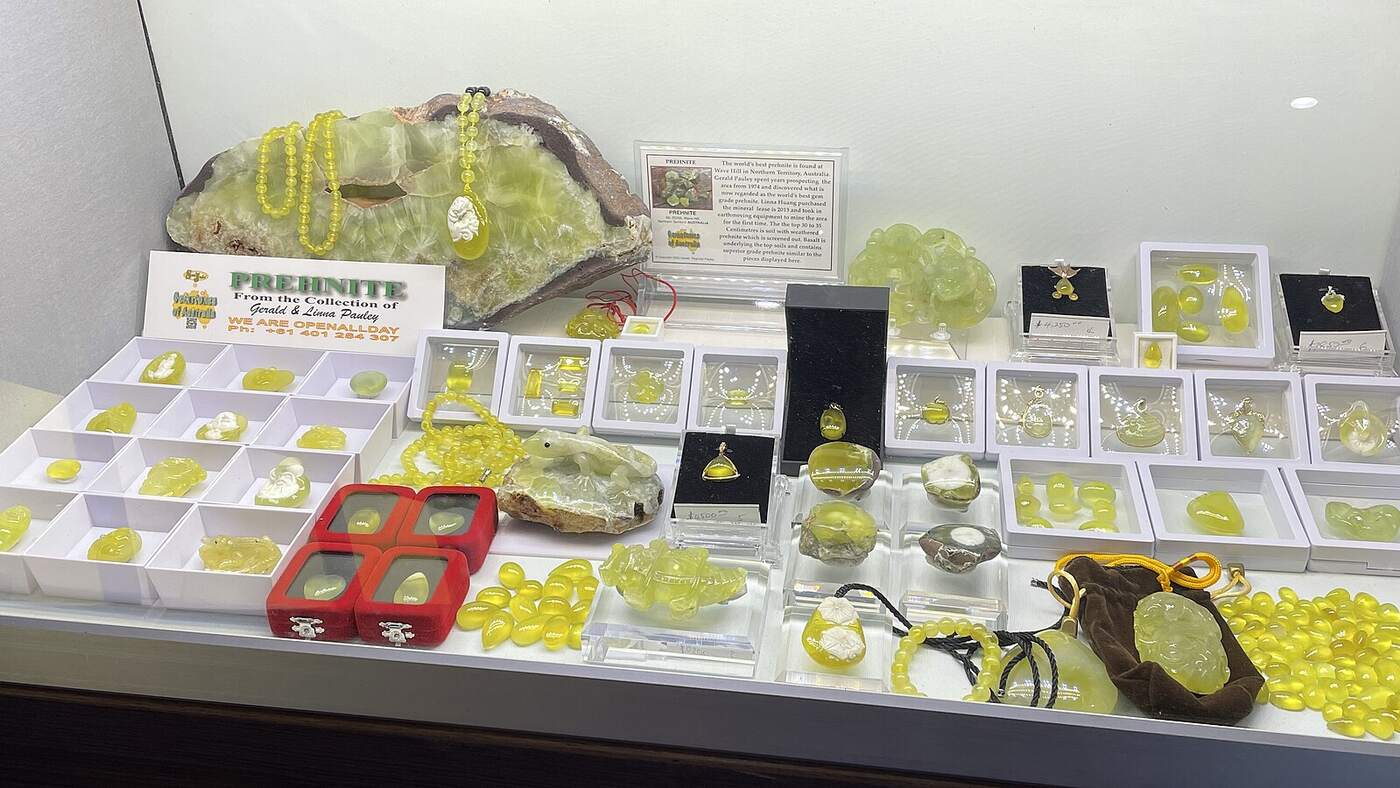
Prehnite is a translucent stone in pale green, yellow-green and, rarely, yellow or orange. Its charm is its glow: light enters and diffuses inside the stone, so that a cabochon looks lit from within, like a green grape held up to a window. Many pieces contain black needles of epidote or actinolite, which designers often keep for contrast rather than cut away.
History
It was named in 1788 after Colonel Hendrik von Prehn, a Dutch officer who brought specimens from the Cape of Good Hope to Europe, and it was the first mineral to be named after a person. In the nineteenth century it was sold as "Cape chrysolite" and "Cape emerald", two of the misleading trade names that still surface on old jewellery.
Colours and what decides the price
Most prehnite is a pale, slightly yellowish green; the more saturated apple green is scarcer and dearer. Orange prehnite from Australia and a rare yellow are collector's colours. Value follows translucency first, colour second and cleanness third: a stone that glows evenly, without cloudy patches, is worth several times one that looks chalky. Even so, prehnite is affordable, and clean cabochons of ten or twenty carats cost what a small precious stone would. Transparent material is occasionally faceted, and a few stones show a cat's eye. Prehnite is not treated; it is not worth anyone's while.
Where it comes from
Australia (Wave Hill in the Northern Territory) supplies much of the gem material; Mali produces the epidote-flecked stones that specimen collectors know; China, South Africa, India (the Deccan traps around Pune), Scotland and the United States (New Jersey) are among the rest. The source matters little to the price.
How it is cut
Mostly as cabochons and beads, where the glow shows best, and sometimes as carvings and spheres. Prehnite is available in generous sizes at modest prices, which makes it a good stone for a bold pendant or a cocktail ring where a precious stone of the same size would be out of reach.
Prehnite or something else
Its look is shared by chrysoprase, jade, serpentine and green glass. Chrysoprase is a more vivid apple green and harder; jade is tougher and heavier; serpentine is softer and waxier; glass has bubbles. A goldsmith with a refractometer settles it in a minute. See how a gemmologist identifies a stone.
Wearing it
With a hardness of 6 to 6.5 and a slight brittleness, prehnite is suited to earrings, pendants and rings worn with some care; a bezel setting protects the edges. Avoid ultrasonic cleaners and heat. Warm water and a soft cloth are enough. See which stones can be worn every day. Describe your piece and a goldsmith can find a stone with the glow you are after.