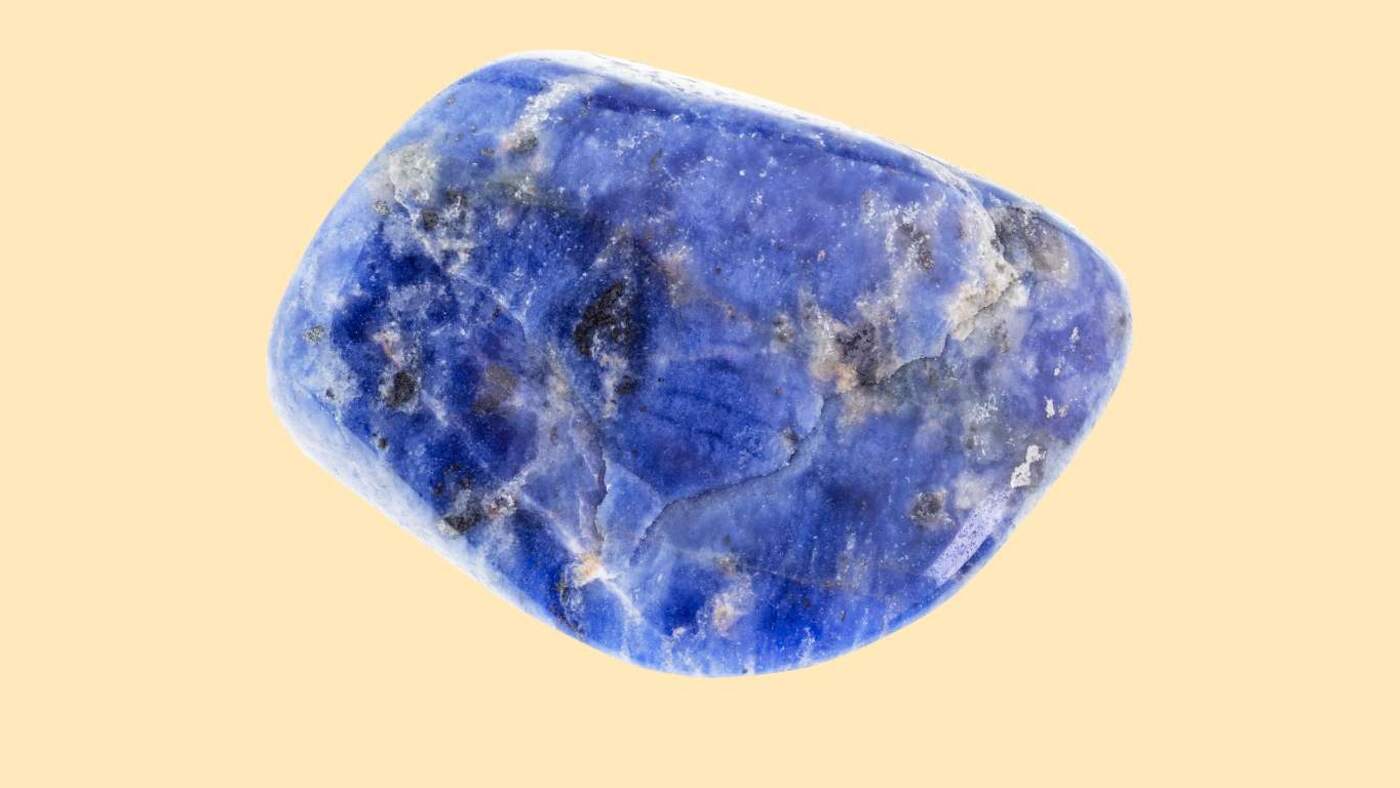
Sodalite is a deep blue mineral, usually veined with white calcite, and it is one of the minerals that make up lapis lazuli. On its own it is more affordable, comes in larger pieces, and has a cooler, more royal blue that suits silver as well as gold.
Sodalite or lapis
Both are blue with white, and both are sold to people who wanted the other. Lapis has a more intense, slightly violet blue and, nearly always, flecks of golden pyrite. Sodalite is a cooler blue without pyrite and often with more white, and it is noticeably lighter for its size; its density is close to that of glass, where lapis is heavier. Under a long-wave ultraviolet lamp most sodalite glows orange, which lapis does not. Price is the other clue: a large, deeply coloured sodalite cabochon costs what a small lapis would.
What a good piece looks like
An even, saturated blue with little white, cut so any calcite veins run as a pattern rather than a blotch. Pale, greyish or heavily veined material is the bottom of the market and is what most inexpensive beads are made of. Sodalite is not treated as a rule; dyed material exists but is uncommon because the natural colour is cheap. Imitations are rare for the same reason. There is no grading and no report.
Hackmanite
A rare variety, hackmanite, is pale pink to violet when it comes out of the ground, fades to white or grey in daylight and returns to pink in the dark or under ultraviolet light, an effect called tenebrescence. Material from Afghanistan and Myanmar shows it strongly; some is transparent enough to facet. It is a collector's stone rather than a jeweller's, because a colour that depends on where the wearer has been is hard to sell, but it makes an unusual pendant for someone who likes a story.
Where it comes from
The classic source is Bancroft in Ontario, Canada, whose sodalite became fashionable in the early twentieth century; Brazil (Bahia) supplies most of the carving material today, with Namibia, Bolivia, Greenland and Russia's Kola peninsula among the others. The source does not change the price.
How it is used
Cabochons, beads, flat plates for inlay, spheres and carvings; its strong colour suits bold, large pieces and men's jewellery, and it is the stone for a blue that lapis would make too costly at that size. Faceted sodalite is rare, because the stone is opaque.
Wearing it
Sodalite has a hardness of 5.5 to 6 and is brittle, so it chips at edges and corners. It suits pendants, earrings, beads and rings with a bezel setting. Keep it away from acids, which attack the calcite veins, and from ultrasonic cleaners; wipe it with a damp cloth. See which stones can be worn every day. Describe your piece and a goldsmith can source a stone in the colour you have in mind.