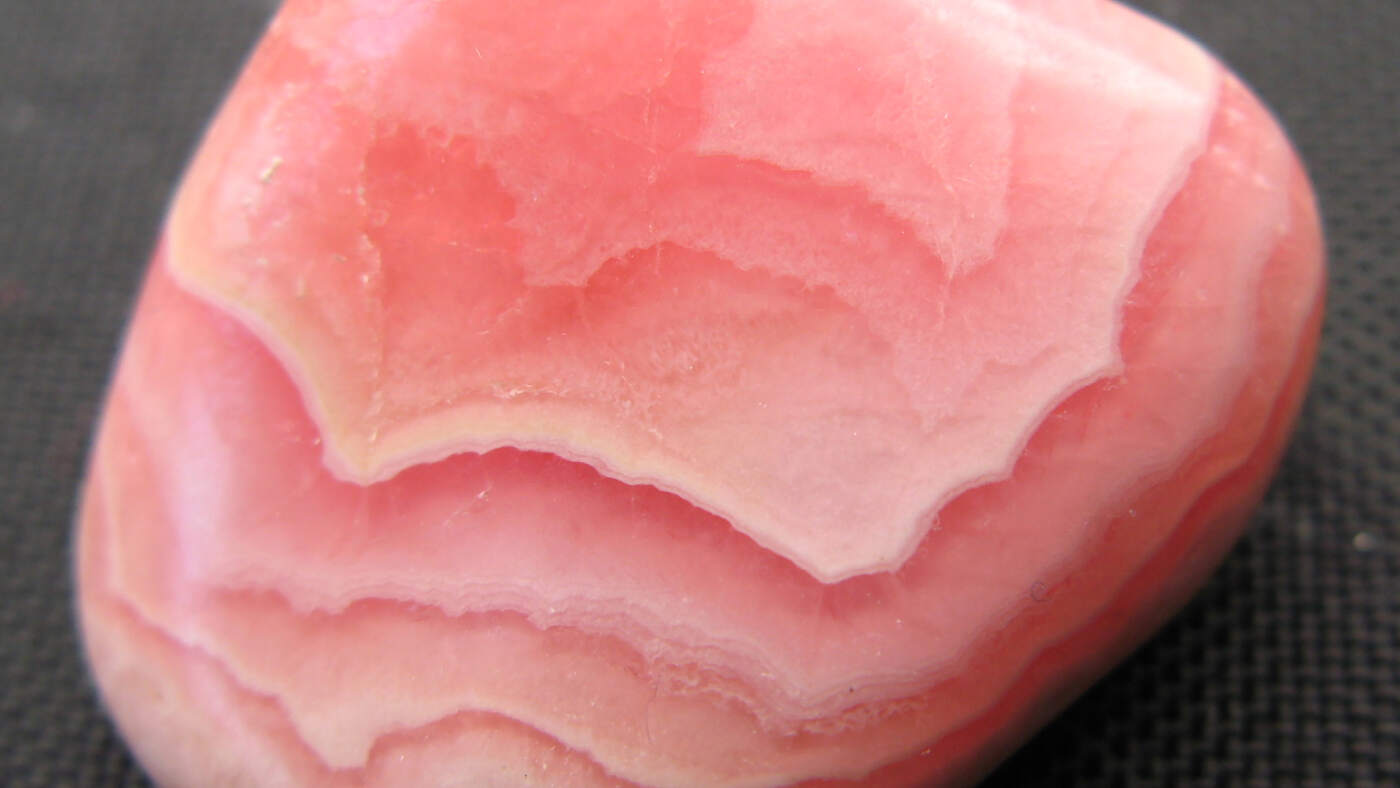
Both take their pink from manganese and both have names from the Greek for rose. They are easy to confuse on a tray and quite different to wear, and each has one famous source that set its reputation.
Rhodochrosite
Rhodochrosite is manganese carbonate and ranges from pale pink to a deep raspberry red. Most of it is banded in pink and white, the layers of stalactites that grew in old mine workings, and is cut as cabochons, beads, spheres and slabs. The classic material comes from the Capillitas mine in Catamarca, Argentina, where it is the national gemstone and where the banded stalactites are sliced into the pink-and-white discs jewellers know. Transparent, deep red crystals from the Sweet Home mine near Alma in Colorado, mined for specimens until 2004, are cut into faceted stones for collectors at prices that rival fine coloured gems; the Kalahari manganese field in South Africa and mines in Peru and Romania produce crystals too.
Value follows the depth of the red and, in banded material, the crispness of the pattern; faceted stones are priced on colour and clarity like any gem. Rhodochrosite has a hardness of only 3.5 to 4, three directions of perfect cleavage, and it fizzes in acid. It is a stone for pendants, earrings, brooches and careful wear, never for a ring worn daily. Keep it away from acids, heat and the ultrasonic cleaner.
Rhodonite
Rhodonite is a manganese silicate, a rose to salmon pink, usually with a web of black manganese-oxide veins running through it, opaque to translucent. It is cut as cabochons, beads, carvings and slabs; the Urals near Yekaterinburg supplied the huge blocks of the Russian imperial workshops, and it is the state gemstone of Massachusetts. Sweden (Långban), Australia, Brazil, Japan and Peru are among the other sources. Rare transparent red crystals from Broken Hill in Australia are faceted for collectors. At 5.5 to 6.5 rhodonite is harder than rhodochrosite and it suits pendants, cufflinks, beads and rings in a bezel setting for occasional wear. Value follows the strength of the pink and the elegance of the black veining; grey, dull material is cheap.
Telling them apart
Rhodochrosite is banded in pink and white; rhodonite is mottled pink with black veins. Rhodochrosite is softer, scratched by a copper coin, and noticeably heavier for its size; a drop of vinegar fizzes on rhodochrosite and does nothing to rhodonite. Both are imitated by dyed marble and resin, which show none of the natural banding or veining. Neither is treated as a rule. See how a gemmologist identifies a stone.
Wearing them
Rhodonite in a protective setting can be worn regularly; rhodochrosite is for pieces that do not take knocks. Both dislike acids, heat and ultrasonic cleaners; warm water and a soft cloth are enough. See which stones can be worn every day. Describe your piece and a goldsmith can source either in the pink you have in mind.