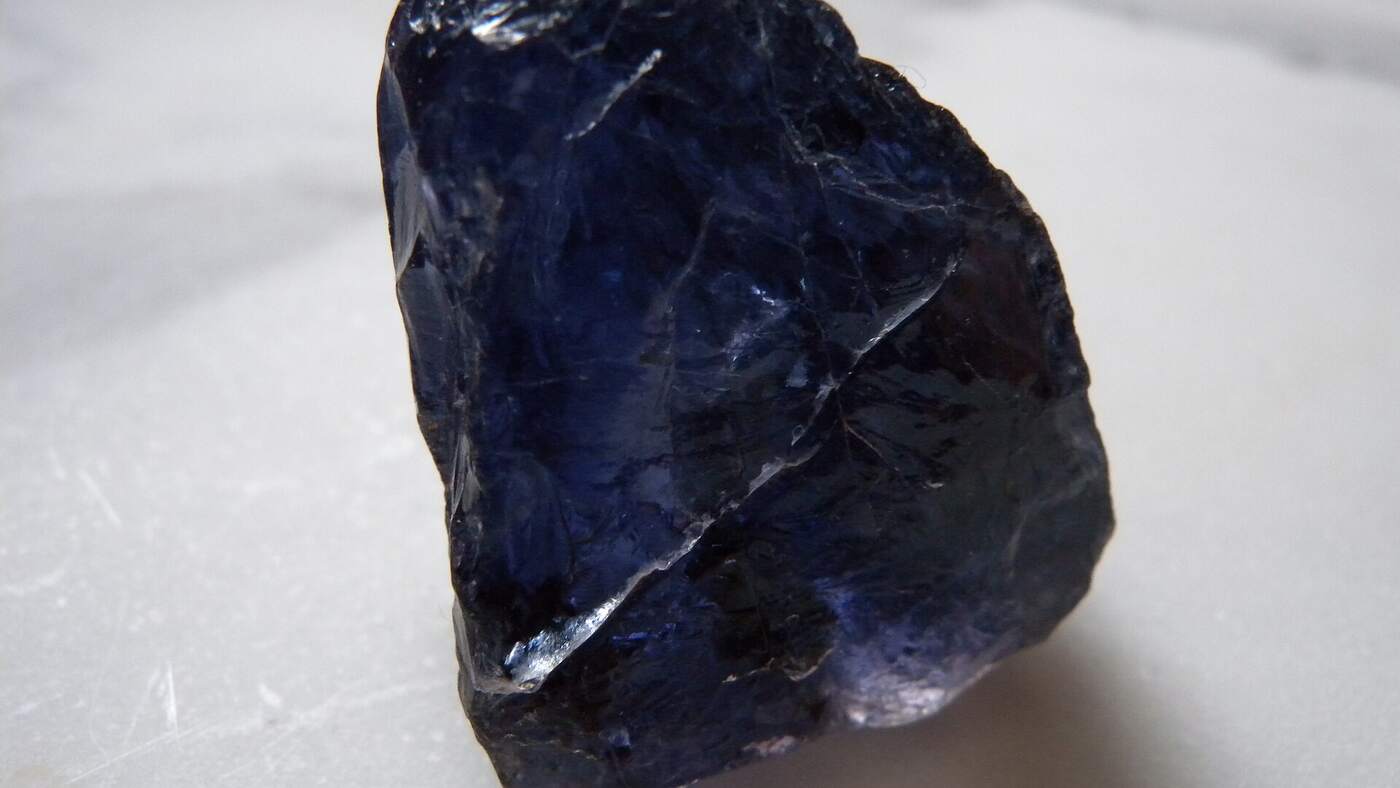
Iolite is the gem variety of the mineral cordierite. Its best colour is a violet-blue that recalls sapphire or tanzanite, and it costs far less than either; it has been sold as "water sapphire" for that reason, one of the misleading trade names to know.
Three colours in one stone
Iolite is one of the most strongly pleochroic gems: the same crystal shows violet-blue from one direction, pale blue-grey from another and near colourless yellowish from the third, and the old name dichroite records it. The cutter orients the stone so that the best blue faces up, at the cost of weight, which is why a well-cut iolite is smaller than the rough promised and a badly cut one looks washed out or greyish from the top. Look at it from above, in daylight, and turn it: the change of colour at the sides is normal and is how you know it is iolite. See optical effects.
The Viking stone
A popular story holds that Norse sailors used thin slices of iolite as a polarising filter to find the sun through overcast skies and steer by it. Cordierite does polarise light and the method works; whether the Vikings used it is unproven, as no such stone has been found in a Viking context. It makes a good story for a piece, told as a story.
Where it comes from
India (Odisha and Madhya Pradesh) supplies most of the market, with Sri Lanka, Tanzania, Madagascar, Brazil and Myanmar; Norway was the historic source and Canada produces some. "Bloodshot" iolite, with red flashes from hematite platelets, comes from Sri Lanka and India and is a collector's curiosity. Origin does not change the price.
What decides the price
Colour first: a saturated violet-blue without the grey that lower grades show. Then clarity, since iolite often carries fine needles and cracks, and then size: clean stones above three or four carats are uncommon, and above ten rare. Even so, iolite is one of the best-value blue gems there is; a fine stone costs a small fraction of a comparable sapphire or tanzanite. Iolite is not treated and there is no synthetic, so what you see is natural; the only thing to watch for is blue glass, which a loupe separates by its bubbles and a refractometer by its reading.
Wearing it
Hardness 7 to 7.5 makes iolite suited to regular wear, but it has a cleavage direction and can chip from a hard blow, and its fine cracks can grow. A protective setting is sensible for a ring, and a pendant or earrings show the colour at its best in any case. Warm water and a soft cloth; no ultrasonic cleaner or steam, and no sudden heat. See which stones can be worn every day. Describe your piece and a goldsmith can source a stone cut for the colour.