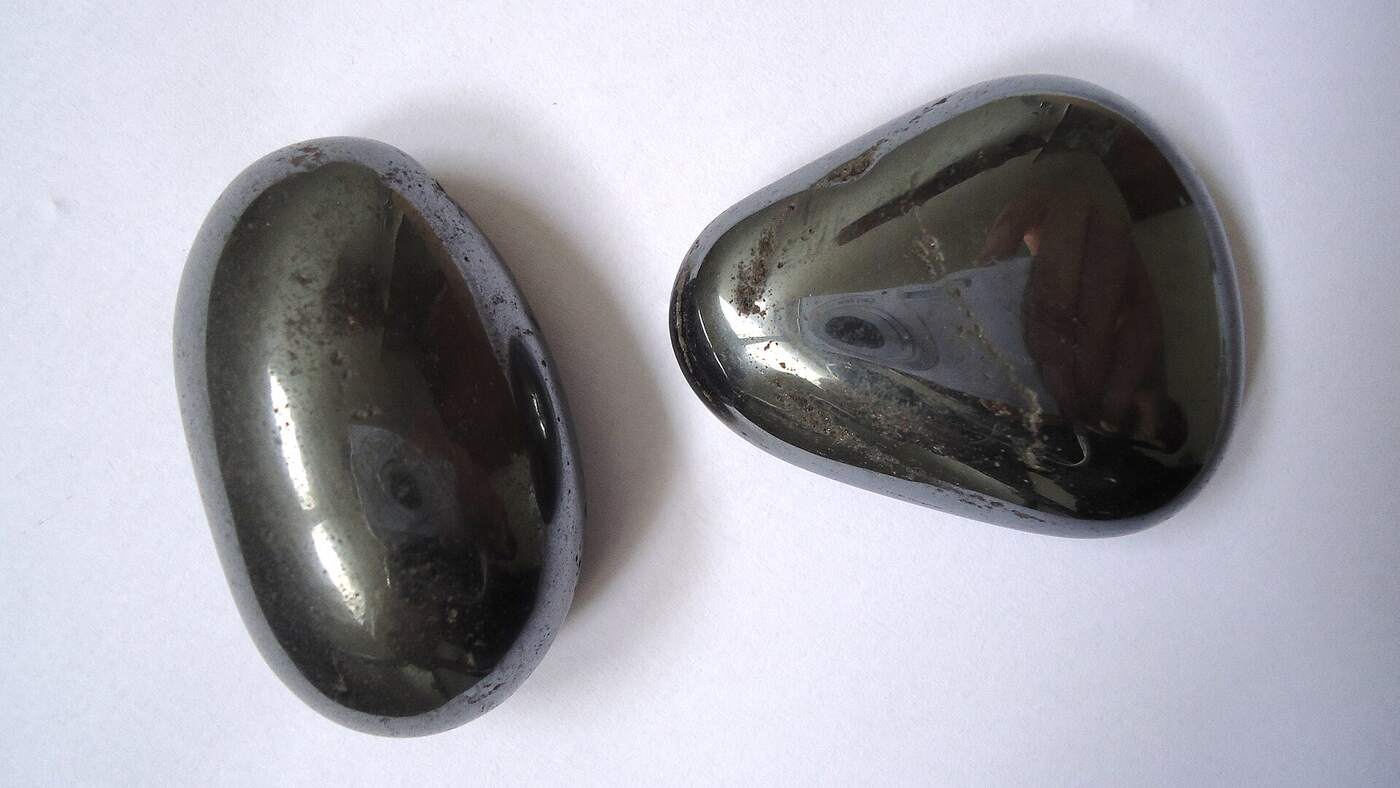
Hematite is iron oxide, the main ore of iron and the pigment of red ochre, rust and the colour of Mars. Polished, it has a metallic lustre like dark steel, and it is heavy: nearly twice the weight of quartz for the same size. Its name comes from the Greek for blood, because a hematite of any colour leaves a red streak when scratched on unglazed porcelain, which is also the quickest way to identify it.
History
The Romans cut hematite into intaglios and seals, and specular hematite from Elba, mined since Etruscan times, gave crystals that still fill museum drawers. In the Victorian period polished hematite sat beside jet in mourning jewellery, and in the twentieth century it became the stone of cufflinks and men's rings. Faceted hematite was sold as "black diamond" and "Alaska black diamond", two misleading trade names.
How it is used
Hematite is cut as beads, cabochons, flat plates and intaglios for signet rings, and carved into small figures. Its cool grey suits men's jewellery and modern, minimal designs, and a faceted bead catches the light like cut steel. Rainbow hematite, with an iridescent surface film, is cut as cabochons. Solid hematite rings, cut from one piece with no metal, are sold cheaply and crack if dropped.
Where it comes from
Brazil (Minas Gerais) supplies most of the cutting material, in dense blocks that take a high polish. England (the kidney ore of Cumbria), Italy (Elba), Germany, Norway and the United States (the iron ranges of Michigan and Minnesota) are the classic sources. Price is low and the source does not change it; the polish and the cut do.
Imitations
Much "hematite" in cheap jewellery is a manufactured, sintered iron oxide sold as hemalyke, hematine or magnetic hematite, made into beads and bracelets by the ton. Natural hematite is not magnetic, or only very weakly. If a magnet sticks to it, it is not the real thing. The streak test settles it too: both leave a red-brown streak, but only the natural stone has a crystalline structure under the loupe, and the imitation is usually too uniform. See synthetic and imitation stones.
Wearing it
Hematite has a hardness of 5.5 to 6.5 and is brittle: it chips at the edges from a knock and its polish dulls with scratching. It suits pendants, cufflinks, beads and brooches. In a ring, a bezel setting protects the edges, and an intaglio in a signet is safer than a raised cabochon. Clean with a soft cloth; keep it away from acids and, like any polished stone, out of a jewellery box where harder stones can scratch it. See which stones can be worn every day. Describe your piece and a goldsmith can cut a signet or set a cabochon.