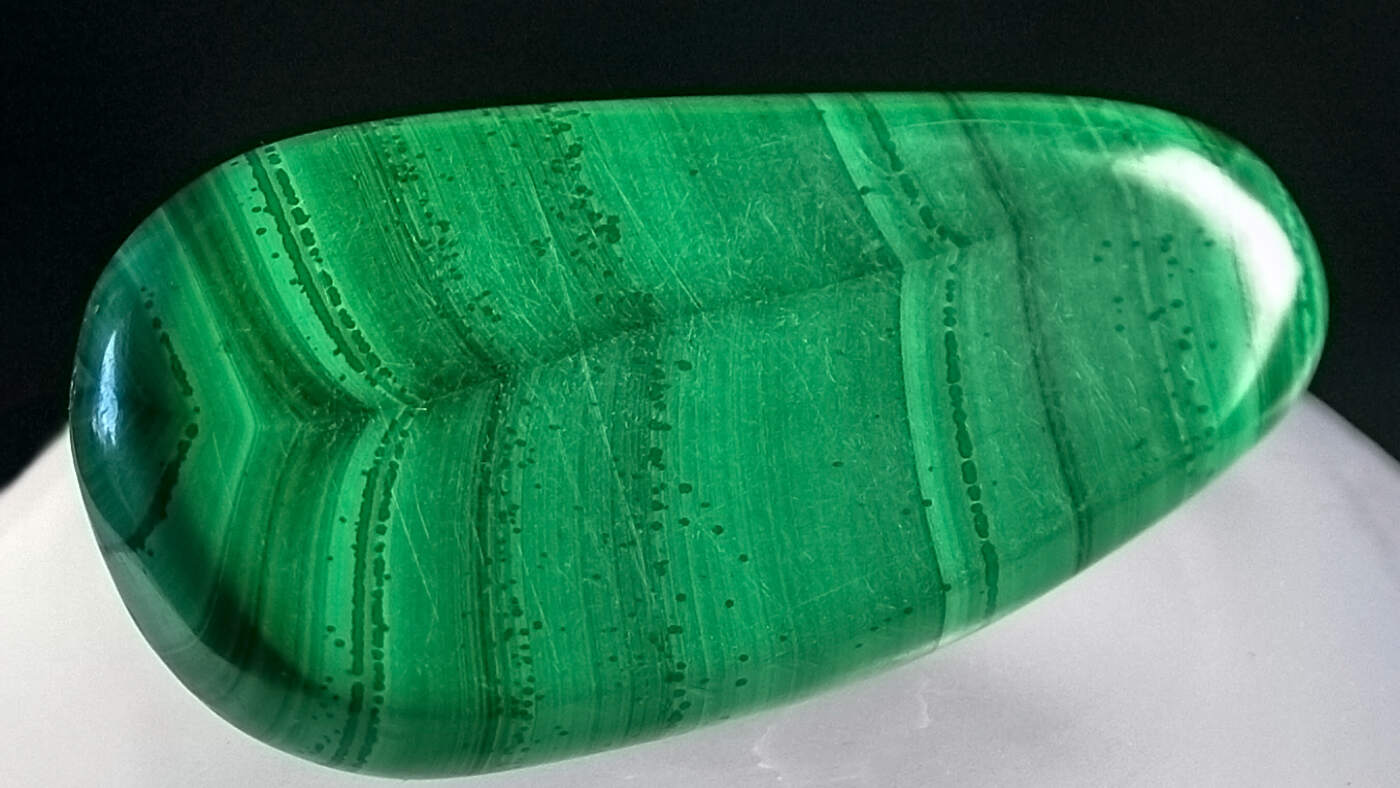
Malachite is a copper carbonate, and its green is as strong as any in the mineral world. Cut across, it shows bands and concentric rings in light and dark green, the growth layers of the botryoidal masses it forms in, and no two pieces are alike. It has been carved since antiquity: the Egyptians ground it into eye paint, the Russian tsars lined rooms with it, and it is still the green stone people mean when they say "malachite green".
How it is used
Malachite is opaque and always cut as a cabochon, bead, flat plate or carving, never faceted. It is used for inlay, for large statement pieces, for boxes and objects, and in men's jewellery, and it takes a high polish that brings out the banding. Because it is soft and cheap to work, large carvings are affordable in a way that no other green stone allows.
Where it comes from
The Democratic Republic of Congo (the Katanga copper belt) is the main source and supplies nearly all cutting material; Zambia, Namibia and Australia produce some. Russian malachite from the Urals, mined out in the nineteenth century, was the famous one and lined the Malachite Room of the Winter Palace; antique Russian pieces are collected.
What decides the price
The pattern first: tight, even banding and "bull's eye" rings are worth more than plain green, and a cabochon cut to centre a ring costs more than one cut for weight. Then the depth and contrast of the greens, and the size and soundness of the piece, because malachite is porous and often has soft patches. It is still an inexpensive stone; the cutter's eye is most of what you pay for.
Wearing it
With a hardness of 3.5 to 4 it scratches easily, and it is brittle. It suits pendants, earrings, brooches and cufflinks. In a ring it wears quickly and needs a protective setting. See which stones can be worn every day.
Care
Malachite reacts with acids and with heat. Never use an ultrasonic cleaner, steam, hot water or any cleaning product; even the acid in sweat dulls its polish over time, which is why old rings look matt. Wipe it with a soft, damp cloth and dry it. Malachite dust is harmful, so cutting and polishing are done wet; a finished, polished stone is safe to wear and handle.
Imitations and stabilising
Some malachite is impregnated with resin to strengthen it, which should be stated. Reconstituted malachite, made from powder and resin, and plastic imitations with printed bands are common in cheap jewellery; real malachite is heavy and cold to the touch, shows irregular banding that is never quite repeated, and has fine radiating fibres inside the bands under a loupe. Dyed magnesite and howlite are sold as malachite too. See synthetic and imitation stones. Describe your piece and a goldsmith can cut a cabochon to the pattern.