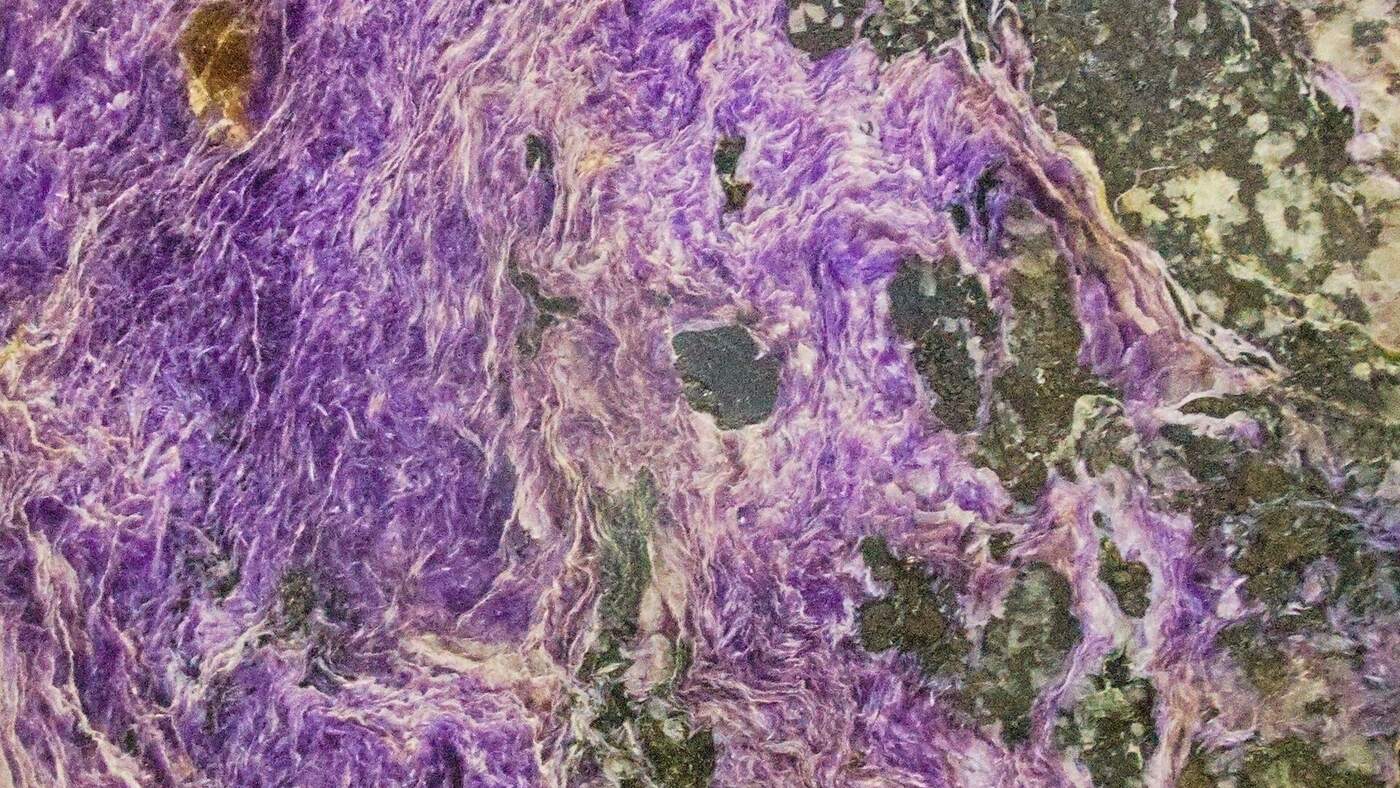
Purple is rare among opaque stones, and both of these were unknown to jewellery until the second half of the twentieth century. Each comes from one place in the world, which makes them a rarity among gem materials and gives a piece set with either a story that is easy to tell.
Sugilite
Sugilite is a deep purple to magenta, opaque to slightly translucent, sometimes with black manganese-oxide veining or brown patches. It was described in Japan in 1944, from a brownish mineral on a small island, and named after the petrologist Ken-ichi Sugi who found it; the purple gem material, coloured by manganese, turned up in 1979 in the Wessels mine in the Kalahari manganese field of South Africa, which remains the only significant source. The mine has largely stopped producing gem sugilite, so fine material is finite and prices have risen.
The finest, evenly coloured and translucent material is called gel sugilite and is not cheap; mottled opaque stone with dark veins is affordable. Value follows the purity and saturation of the purple, translucency and the absence of black. It is cut as cabochons, beads, inlay and carvings, and has been sold under the trade names Royal Azel and Royal Lavulite. Hardness 6 to 6.5.
Charoite
Charoite has a swirling pattern of lilac, violet and white, often with black aegirine needles and orange tinaksite flecks, like brushed silk, and the fibres give the best pieces a soft sheen that moves with the light. It comes from a single deposit in the Murun massif on the Chara river in Sakha, Siberia, described in 1978, and nothing like it is known anywhere else. It is cut as cabochons, beads and carvings, and larger slabs go into boxes, inlay and clock faces. Value follows the strength of the violet, the liveliness of the swirl and the sheen; pale, grey-lilac material is the bottom of the market. Hardness 5 to 6.
Imitations
Both are imitated. Dyed quartzite, dyed howlite and resin composites are sold as sugilite; "charoite" cast from purple resin with painted swirls is common in cheap jewellery. Real stones show fine natural variation in colour and pattern, tiny inclusions of other minerals, and none of the round bubbles of resin. Under a loupe, the fibrous structure of charoite is unmistakable. A goldsmith recognises both; for a stone at a high price, an identification is worth asking for. See synthetic and imitation stones.
Wearing them
Both suit pendants, earrings, beads and rings in a protective bezel setting. Neither should go into an ultrasonic cleaner or come near heat or acids, and both scratch in a jewellery box beside harder stones. Purple against silver is the classic combination; sugilite beside yellow gold is bolder. See which stones can be worn every day. Describe your piece and a goldsmith can source a cabochon.